For Singapore-based businesses choosing between 8×8 CPaaS and Twilio for SMS, WhatsApp and OTP, the right choice may depend on what you’re building, how much you expect to send, which channels you need and how much support you want during implementation.
If you’re specifically looking for a Twilio alternative in Singapore, the short version is this: Twilio tends to suit teams that want a broad developer ecosystem and want to build highly customised messaging workflows themselves. 8×8 CPaaS tends to suit businesses that want SMS, WhatsApp, voice and verification to sit together in one platform, backed by local support.
Is 8×8 CPaaS a Twilio Alternative in Singapore for SMS and SMS API?
If SMS is a core part of your customer communications, the comparison goes beyond the cost of sending each message. You also need to consider reach, delivery, Sender IDs, routing, analytics and how easily SMS fits into your existing systems.
Both 8×8 CPaaS and Twilio provide SMS APIs for transactional and bulk messaging, with global reach and tools to manage delivery and compliance. The differences become clearer when you look at how each platform handles the wider messaging picture.
| Feature | 8×8 CPaaS | Twilio |
| SMS API | Yes | Yes |
| Global reach | 160+ direct mobile network operators in 190+ countries | Messaging coverage across 180+ countries |
| High-volume messaging | Yes | Yes |
| Transactional messaging | Yes | Yes |
| Bulk SMS | Yes | Yes |
| Two-way SMS | Yes | Yes |
| Custom Sender ID | Yes | Yes |
| Intelligent routing | Automated route selection across direct operator connections | Automated routing with deliverability optimisation tools |
| Message adaptation | Auto-adapts messages, phone numbers and Sender ID formats | Sender and compliance tooling to adapt messaging by market |
| Number lookup | Yes | Yes |
| Delivery analytics | Yes | Yes |
| Compliance support | Compliance tools and dedicated support | Compliance tools and local guidelines |
| Integrations | APIs, applications and developer resources | APIs, SDKs, integrations and sample apps |
| Support | 24/7 in-country dedicated support | Global support and developer resources |
What Can You Do With 8×8 CPaaS for SMS?

8×8 SMS APIs are built for businesses that need to send everything from individual notifications to high-volume SMS campaigns.
Its SMS API supports transactional and bulk messaging, while two-way SMS lets you handle replies as part of the same communication flow. You can also use a custom Sender ID to keep your company name visible to recipients rather than relying on a phone number.
For businesses sending SMS across different markets, 8×8 CPaaS connects to 160+ direct mobile network operators across more than 190 countries. Intelligent routing automatically selects suitable routes for delivery, while its auto-adaptation capabilities adjust message, phone number and Sender ID formats where needed.
You can also use Number Lookup to check phone number validity and location, which can help with database cleaning and fraud prevention.
For teams managing large-scale messaging, the platform is designed to scale from hundreds to millions of messages. Delivery and performance can be monitored through the platform, with 24/7 in-country support available when you need help.
What Can You Do With Twilio for SMS?
Twilio’s Programmable Messaging API lets you send SMS, MMS and WhatsApp messages through a single API, while its wider communications stack also covers RCS, voice and email.
For SMS specifically, Twilio supports high-volume messaging across 180+ countries, with localised senders, compliance tools and guidance for different markets.
You can use its messaging APIs for transactional notifications, alerts and other customer communications, while its Conversations API supports two-way engagement across SMS, MMS, chat, Facebook Messenger and WhatsApp.
Twilio also provides real-time analytics for monitoring message delivery and engagement, alongside developer resources such as SDKs, quick-starts and sample applications. This can be useful if you have a development team building more customised messaging workflows or want SMS to sit alongside several other communication channels.
8×8 CPaaS vs Twilio for SMS: The Takeaway
If you want a highly developer-focused SMS platform with extensive APIs, SDKs and developer resources, Twilio offers a broad ecosystem for building customised messaging workflows.
If you want SMS alongside direct operator connectivity, intelligent routing, message adaptation, local support and broader customer communication channels, 8×8 CPaaS may be a relevant fit.
8×8 CPaaS vs Twilio for WhatsApp Business API
If WhatsApp is an important customer channel for you, the comparison goes beyond the cost of sending a message. Look at what you can build on WhatsApp, how customers can interact with your business, and how easily those conversations connect to your wider customer service and communications setup.
Both 8×8 CPaaS and Twilio support the WhatsApp Business Platform, including two-way messaging, notifications, templates and WhatsApp-based verification. The difference becomes more apparent when you look at the wider customer journey each platform can support
| Feature | 8×8 CPaaS | Twilio |
| WhatsApp Business Platform | Yes | Yes |
| Two-way messaging | Yes | Yes |
| WhatsApp Flows | Yes | Yes |
| Marketing messages | Yes | Yes |
| WhatsApp verification | Yes | Yes |
| CRM integrations | Integrations with Salesforce, Zendesk, Freshdesk and other business systems | Integrations available through Twilio’s APIs and broader integration ecosystem |
| WhatsApp Business Calling | Yes, integrated into 8×8 Converse | Yes |
| Voice and messaging in one conversation | Yes | Yes |
| Analytics and reporting | Delivery, engagement and conversion tracking | Messaging and verification insights |
| Broader communications channels | WhatsApp, SMS, email, voice and web chat | WhatsApp, SMS, RCS, voice and email |
What Can You Do With 8×8 WhatsApp Business API?

8×8 WhatsApp Business API is built around two-way WhatsApp conversations, allowing you to move beyond one-way notifications and create more interactive customer journeys.
You can use WhatsApp to send appointment reminders, confirmations, order updates and other automated notifications, while giving customers a way to respond directly. WhatsApp Flows can take this further by letting you build structured, multi-step interactions within WhatsApp itself, such as collecting information or guiding customers through a process without sending them to another website.
For marketing, you can send personalised promotional messages to opted-in customers, with AI-powered delivery optimisation designed to improve message reach based on campaign performance.
8×8 CPaaS also connects WhatsApp interactions with business systems such as Salesforce, Zendesk and Freshdesk, helping teams keep customer information and conversation history in one place.
WhatsApp Business Calling
One notable capability of 8×8 CPaaS is WhatsApp Business Calling, which brings voice calling into the same WhatsApp conversation.
Customers can call your business directly from WhatsApp, while agents can see the existing message history when they answer. Businesses can also make outbound WhatsApp calls for follow-ups, confirmations or more complex support interactions.
This means a conversation can move from automated messaging to two-way chat to voice support without forcing the customer to switch channels.
With 8×8 Converse, a unified agent workspace, these interactions can be managed alongside other channels such as SMS, email, voice and web chat. Agents can access customer profiles and conversation history, while features such as intent detection, suggested responses and sentiment analysis support the interaction.

What Can You Do With Twilio WhatsApp Business API?
Twilio also supports WhatsApp as part of a broader communications stack covering WhatsApp, SMS, RCS, voice and email.
Its WhatsApp capabilities cover common use cases such as real-time alerts, order updates, appointment reminders, customer support and two-way messaging. You can also build WhatsApp into verification flows alongside SMS, RCS, voice, email and other authentication channels.
For developers, Twilio provides APIs for managing WhatsApp senders and supporting features such as WhatsApp Flows, typing indicators, interactive messaging and payments. Its WhatsApp Business Calling capabilities can also connect calling streams with IVRs, bots, call recording and speech-to-text tools.
For customer service, you can use automated self-service and AI-powered conversations before escalating to a live agent or voice call. This makes Twilio particularly suitable if you’re building a highly customised communications experience around APIs and integrations.
8×8 CPaaS vs Twilio for WhatsApp Business API: The Takeaway
If you want to build a highly customised, API-driven WhatsApp experience and connect it to a broad developer ecosystem, Twilio offers a strong set of developer tools and integrations.
If you want WhatsApp to sit within a broader customer engagement environment, with CRM integrations, WhatsApp Business Calling, Flows, analytics and a unified agent workspace across channels, 8×8 CPaaS may be a relevant fit.
8×8 CPaaS vs Twilio for OTP and Verification
If you’re building OTP verification, the cost of each verification is only part of the decision. You also need to consider which channels you can use, how much of the verification flow is managed for you, and what happens when SMS isn’t the best option.
| Feature | 8×8 CPaaS | Twilio |
| SMS verification | Yes | Yes |
| WhatsApp verification | Yes | Yes |
| Voice verification | Yes | Yes |
| Email verification | Yes | Yes |
| OTP generation and validation | Yes | Yes |
| Channel fallback | Falls back across SMS, WhatsApp and voice | Falls back across SMS, WhatsApp, voice, email and TOTP |
| Silent authentication | Silent Mobile Authentication (passive, carrier-based verification with no code entry) | Silent Network Authentication (Twilio’s equivalent network-level check) |
| Fraud and security | Omni Shield for detecting and preventing fraudulent verification traffic | Fraud Guard for fraud monitoring and prevention |
| Analytics | Delivery and conversion dashboards | Verification insights and reporting |
What Can You Do With 8×8 Verification API?
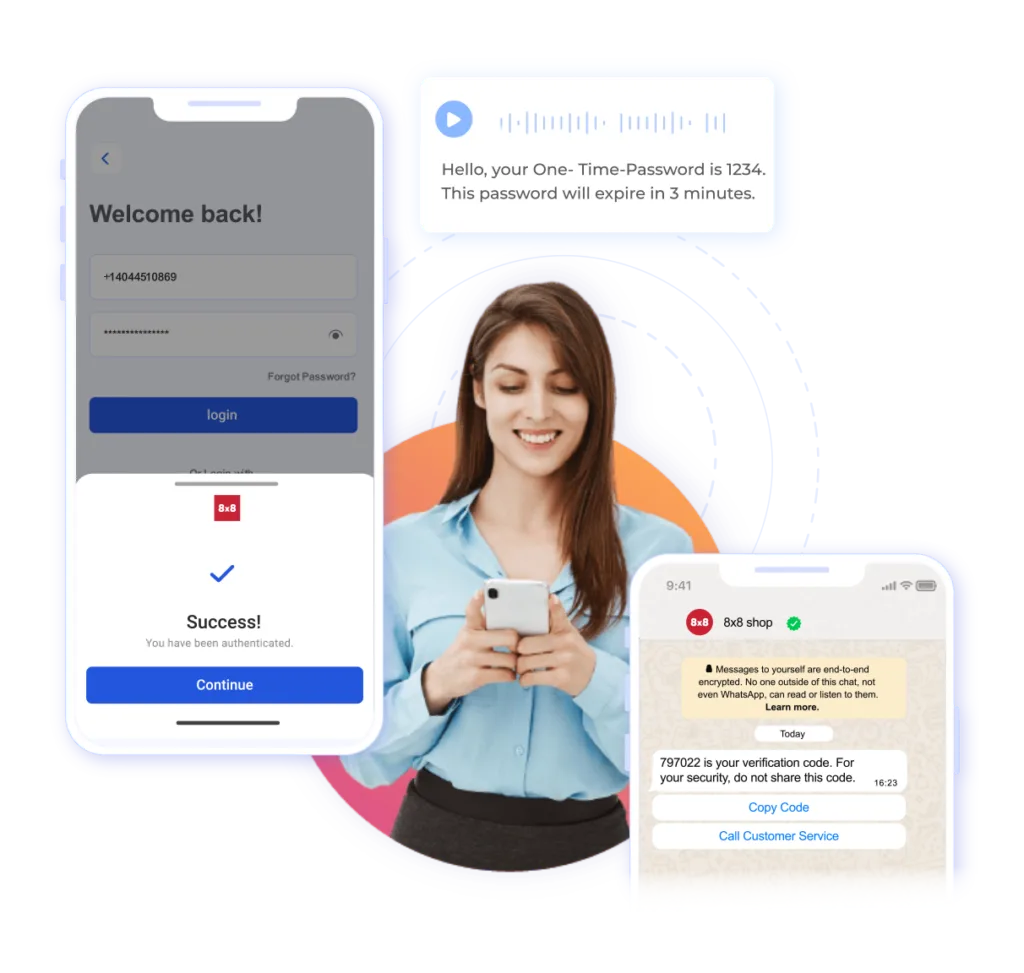
The 8×8 Verification API is designed to help you build verification into sign-ups, logins, account recovery and transactions without having to manage the entire OTP process yourself.
You can send one-time passwords through SMS, WhatsApp or voice, giving you options when a user doesn’t receive or can’t use their first-choice channel. For example, you can start with an SMS OTP and switch to a voice message when needed, helping reduce drop-offs during verification.
You can also use Silent Mobile Authentication for a more frictionless verification experience, where supported. This can reduce the need for users to manually enter a code while still verifying their identity.
For ongoing optimisation, 8×8 CPaaS provides dashboards to track message delivery, conversion rates and overall verification performance. This gives you visibility into where users may be dropping off and how your verification flows are performing.
For high-volume verification traffic, Omni Shield adds a layer of fraud protection to help detect and prevent suspicious activity, including SMS pumping, toll fraud and artificially inflated traffic. This gives businesses another layer of protection alongside the controls used to manage the verification process itself. Omni Shield has been named Cybersecurity Initiative of the Year (Singapore) at the Asian Telecom Awards 2026.

What does Twilio Verify offer?
Twilio Verify is a turnkey verification API that manages key parts of the authentication flow, including connectivity, channels, code generation and fraud monitoring.
You can build verification using SMS, WhatsApp, email and TOTP (time-based one-time passcodes generated by an authenticator app), or use Silent Network Authentication (SNA) for a more frictionless experience. Twilio also provides rate limiting and fraud monitoring to help protect verification flows from abuse, alongside route optimisation to prioritise deliverability and speed.
Additionally, Twilio has expanded its verification capabilities with device-level risk signals through Stytch by Twilio Device Fingerprinting, which can provide additional context when deciding whether a user should undergo stronger verification.
Twilio also provides Fraud Guard, along with rate limiting and other fraud monitoring capabilities, to help protect verification flows from abuse. Route optimisation can also help prioritise deliverability and speed.
8×8 CPaaS vs Twilio for OTP Verification: The Takeaway
If you need a developer-focused verification service with multiple authentication channels, fraud controls and tools for building customised verification workflows, Twilio Verify provides a broad set of options.
If you want verification across SMS, WhatsApp and voice, with channel fallback, Silent Mobile Authentication and performance monitoring integrated into a broader CPaaS environment, 8×8 CPaaS may be a relevant fit.
How Do 8×8 and Twilio Compare for Integrations and Developer Experience?
Both 8×8 CPaaS and Twilio provide APIs for integrating communications into applications and business workflows. The difference is more apparent in the surrounding developer resources, integrations and support available when you move beyond the initial API connection.
Twilio offers an extensive developer ecosystem, with APIs, SDKs, documentation, quickstarts, sample applications and integrations across messaging, voice, email and other communication channels. This can suit development teams that want to build highly customised communication workflows directly into their applications.
8×8 CPaaS also provides APIs, SDKs and webhooks, while connecting communications with enterprise systems such as CRM and contact-centre platforms. Its broader CPaaS offering brings SMS, WhatsApp, voice and other channels together, with 24/7 in-country support and dedicated account support available for businesses that need help beyond the technical integration.
8×8 CPaaS vs Twilio for Integrations and Developer Experience: The Takeaway
If your priority is developer flexibility, extensive documentation and a large ecosystem of APIs, SDKs and developer resources, Twilio may suit teams building highly customised communication applications.
If you want API-based communications combined with enterprise integrations, contact-centre capabilities, local support and multiple communication channels, 8×8 CPaaS may be a relevant fit.
Which CPaaS Features Matter for Singapore Businesses?
The right CPaaS provider depends on more than the number of APIs or messaging channels available. For businesses operating in Singapore, local messaging requirements, connectivity, support and the ability to scale across channels can be just as important.
Here are some of the factors worth considering:
- Singapore Sender ID support: If you send SMS using alphanumeric Sender IDs in Singapore, check how the provider supports the SMS Sender ID Registry (SSIR) and the registration process required for your use case. 8×8 CPaaS is a Tier-1 aggregator registered with the SSIR, providing direct support for registered Sender ID requirements in Singapore.
- Local connectivity: Direct connections to mobile network operators can give businesses greater control over messaging routes and reduce reliance on additional intermediaries.
- Message routing and adaptation: Look for routing capabilities that can select appropriate delivery paths and adapt messages, phone numbers or Sender ID formats where required.
- Omnichannel communications: If your customer journeys extend beyond SMS, consider whether the provider can support WhatsApp, voice and other channels through the same communications infrastructure.
- Enterprise integrations: Check whether the platform can connect with your CRM, contact centre, backend systems and other business applications through APIs, SDKs, webhooks or native integrations.
- Support: For customer-facing communications and authentication, access to technical support can matter when issues need to be diagnosed quickly. Businesses operating in Singapore may also value in-country support.
- Scalability: Consider whether the provider can support both day-to-day transactional messaging and sudden increases in volume, such as campaigns, authentication traffic or customer notifications.
- Pricing structure: Compare the full cost of your expected use case, including message fees, setup or subscription fees, channel fees, verification fees and any applicable carrier or platform charges.
- Security and compliance: Check what security controls, certifications and compliance-related tools the provider offers, while recognising that your business remains responsible for meeting applicable regulatory and data-protection requirements.
For your Singapore businesses, the most relevant CPaaS provider is therefore likely to depend on the channels you need, how deeply you need to integrate them, your messaging volume, support requirements and the level of local infrastructure and compliance support you expect.
How Can 8×8 CPaaS Support Your Customer Communications?
Choosing a CPaaS provider is only one part of the decision. You also need the infrastructure, integrations and support to put your messaging and verification workflows into practice.
8×8 CPaaS brings SMS, WhatsApp, and OTP capabilities together, with APIs and enterprise integrations that can connect communications to your existing systems.
With 8×8 CPaaS, your business can:
- Connect across channels: Use SMS, WhatsApp, voice and other communication channels through a unified CPaaS platform.
- Reach customers through direct connectivity: Connect to 160+ mobile network operators across 190+ countries through 8×8’s direct operator relationships.
- Support Singapore messaging requirements: Manage Sender IDs and other messaging considerations relevant to Singapore.
- Build verification workflows: Verify users through SMS, WhatsApp and voice, with additional authentication options such as Silent Mobile Authentication.
- Integrate with business systems: Connect APIs and communications workflows with CRM, contact centre and other enterprise systems.
- Monitor communications: Access delivery, engagement and verification performance data to understand how your communications are performing.
- Get local support: Access 24/7 in-country customer and technical support, with dedicated account support for businesses that need it.
- Scale as requirements grow: Support everything from transactional messages and OTPs to high-volume customer communications across markets.
8×8 has also received industry recognition for its CPaaS and cybersecurity capabilities. The company was named Best CPaaS Platform at the CX Awards 2025, highlighting its composability and ability to integrate different communications tools on a modular platform.
Whether you’re evaluating a Twilio alternative in Singapore, looking to consolidate messaging channels or building new SMS, WhatsApp or verification workflows, 8×8 CPaaS provides the infrastructure and support to help you put those communications into practice.
Talk to 8×8 CPaaS to explore the right communications setup for your business.
Frequently Asked Questions
- Is 8×8 CPaaS a Twilio alternative in Singapore? Yes. 8×8 CPaaS can serve as an alternative to Twilio for businesses that need SMS, WhatsApp, voice and verification APIs in Singapore. The two platforms differ in areas such as pricing structure, developer experience, integrations, messaging infrastructure, support and broader customer engagement capabilities, so the right option depends on your specific requirements.
- Is 8×8 CPaaS cheaper than Twilio in Singapore? Pricing depends on the channel, messaging volume, routing, plan and usage. Twilio generally charges per message or verification, while 8×8 CPaaS offers different pricing structures depending on the service and plan. For WhatsApp and other Meta-supported channels, both providers may also charge provider fees alongside applicable Meta fees. Businesses should compare total costs based on their expected usage rather than a single headline rate.
- Can I use 8×8 CPaaS for WhatsApp Business API? Yes. 8×8 CPaaS supports WhatsApp Business communications, including two-way messaging, notifications, WhatsApp Flows, marketing messages and integrations with business systems. It can also bring WhatsApp together with channels such as SMS and voice as part of a broader customer communication setup.
- Which is better for OTP verification, 8×8 or Twilio? Neither platform is universally better for every OTP use case. Twilio Verify provides a dedicated verification service with multiple channels and fraud-related controls, while 8×8 Verification API supports verification through SMS, WhatsApp and voice, along with channel fallback and Silent Mobile Authentication. The relevant choice depends on the channels, authentication flow, integrations and security requirements of your application.
- Do 8×8 CPaaS and Twilio support SMS Sender ID registration in Singapore? Both providers can support businesses using SMS Sender IDs in Singapore, but registration and usage requirements still apply. Businesses using alphanumeric Sender IDs should understand the requirements of Singapore’s SMS Sender ID Registry (SSIR) and confirm how their chosen provider handles registration and messaging routes.
- Can 8×8 CPaaS and Twilio integrate with CRMs? Yes. Both platforms provide ways to connect communications with business systems. 8×8 CPaaS supports enterprise integrations through APIs, SDKs and webhooks, as well as integrations with CRM and contact-centre systems. Twilio also provides APIs, SDKs and an extensive integration ecosystem for connecting communications to applications and business workflows.
- Which should I choose: 8×8 CPaaS or Twilio? The choice depends on your requirements. Consider factors such as the communication channels you need, developer resources, messaging volume, CRM and contact-centre integrations, Singapore-specific messaging requirements, pricing structure and the level of local support you expect. Comparing these criteria against your actual use case can help you determine which platform is the better fit.