Sending one SMS to a customer is simple. Sending 100,000 messages at once, while making sure the right people receive the right content, at the right time, and can opt out appropriately, is a different challenge.
A bulk SMS campaign in Australia lets you send text messages to large groups of recipients at the same time, making it useful for promotions, announcements, event updates and customer engagement.
But a successful SMS blast in Australia involves more than uploading a contact list and pressing send. You also need to consider consent under the Spam Act 2003, Sender ID requirements, message content, audience segmentation and delivery performance.
The goal is not simply to reach as many people as possible. It is to reach the right people with the right message, while giving them an appropriate level of control over what they receive.
In this guide, we’ll look at how to plan, target and optimise bulk SMS campaigns in Australia, from building your audience and crafting your message to managing consent, compliance and delivery.
What Is an SMS Blast or Text Blast?
An SMS blast is a bulk messaging campaign where you send the same or similar SMS content to a large group of recipients at once. A text blast is simply another term for the same approach.
Using an SMS platform or API, you can connect to or upload your recipient list, create your message and send it to a large audience without needing to message each customer individually.
Businesses commonly use bulk SMS for:
- Promotional campaigns
- Flash sales and special offers
- Event invitations and reminders
- Product launches
- Customer announcements
- Service notifications
- Surveys and feedback requests
- Appointment or booking reminders
- Time-sensitive updates
But sending a message to thousands of people does not automatically make it a successful campaign.
Bulk SMS is the delivery method. SMS marketing is what you do with it. Your audience, message, timing and targeting all influence whether recipients engage with your campaign, while consent and other applicable requirements determine who you can contact in the first place.
A well-planned SMS blast therefore combines the reach of bulk messaging with thoughtful audience segmentation, relevant content and the right compliance controls.
When Should a Business Use Bulk SMS Marketing?
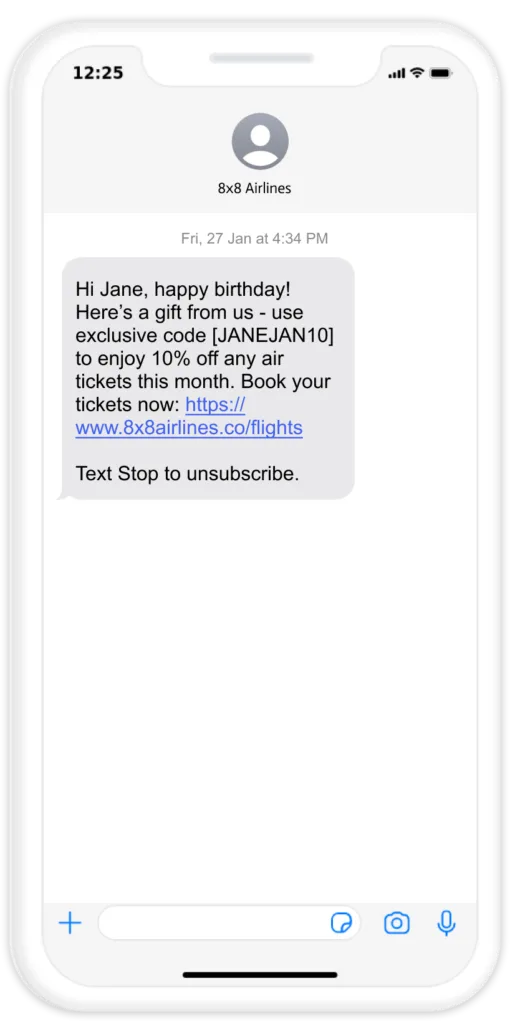
Bulk SMS works best when you need to reach a large audience quickly with a message that is relevant and easy to act on. In Australia, SMS can also work alongside WhatsApp and Facebook Messenger as part of an omnichannel strategy.
For example, an Australian retailer launching a weekend promotion could send a targeted SMS to customers who have opted in to receive marketing communications. A property company could notify registered prospects about an upcoming viewing event, while an event organiser could remind registered attendees shortly before an event begins.
Some common use cases include:
| Use case | Example SMS campaign |
| Retail promotion | “Weekend sale starts tomorrow. Enjoy 20% off selected items.” |
| Event marketing | “Sydney Tech Summit starts next week. Register before 30 September.” |
| Product launch | “Our new collection is now available. Explore it at [link].” |
| Customer engagement | “Tell us what you think in our 2-minute survey: [link]” |
| Service announcement | “Our service centre will operate on revised hours this public holiday.” |
| Appointment reminder | “Reminder: Your appointment is tomorrow at 3 pm. Contact us if you need to reschedule.” |
The important part is choosing the right audience and message for each campaign. Sending the same SMS to your entire database may be easy, but it does not necessarily make sense for every customer.
For example, you could segment your audience by purchase history, location, customer type or previous engagement and tailor your campaign accordingly. A new product launch might be relevant to recent customers, while an event invitation could be limited to prospects in a specific location.
See infographic: Text Like a Pro: 8 Simple Rules for SMS & WhatsApp Marketing
How Do I Send Bulk SMS to Thousands of Contacts in Australia?
If you need to reach thousands of customers at once, an SMS marketing platform can help you manage everything from organising your contact lists to sending campaigns and tracking delivery.
A typical bulk SMS Australia workflow involves five stages:
- Build your recipient list: Start with contacts you are permitted to message and make sure their information is accurate and up to date.
- Segment your audience: Group contacts by factors such as customer type, location, interests or previous interactions so you can send more relevant messages.
- Create and review your message: Keep your SMS concise, make the purpose clear and check that your links, Sender ID and opt-out instructions are correct where applicable.
- Send your campaign: Use an SMS marketing platform or API to distribute the message to your selected audience.
- Monitor delivery and performance: Review delivery results and campaign data to identify issues and understand how your audience responded.
For larger campaigns, you can automate much of this process rather than repeatedly uploading spreadsheets and sending messages manually.
A typical setup might look like:
CRM/customer database → Audience segmentation → SMS marketing platform → SMS gateway → Mobile networks → Customer device
Delivery data can then flow back into your messaging platform or business system, giving your team visibility into which messages were delivered and which failed.
This also gives you useful campaign data to refine future sends, whether that means improving your audience segments, adjusting your message or reviewing delivery issues.
8×8 CPaaS enables businesses to send bulk SMS through the 8×8 Connect platform, for instance, giving your marketing team a way to manage large-scale sends and monitor delivery without having to manually send and track individual messages.
Bulk SMS Campaign Best Practices: What Should I Check Before Sending a Text Blast in Australia?
Before you send an SMS blast, work through the campaign from audience selection to delivery. A few checks before you hit send can help you avoid sending the wrong message to the wrong people, or replicating a mistake across thousands of recipients.
1. Define your campaign objective
Start with one clear goal. Are you trying to:
- Generate sales?
- Drive event registrations?
- Promote a new product?
- Bring customers back?
- Collect feedback?
- Drive traffic to your website?
Your objective should guide your audience, message, call to action and campaign metrics.
For example, a retail campaign might aim to drive purchases, while an event campaign could focus on registrations. Trying to achieve several unrelated objectives in one short SMS can make the message less focused.
2. Define your audience
Your entire customer database does not need to receive every campaign. Segment your audience based on who the message is actually relevant to.
You could segment recipients based on:
- Previous purchases
- Customer status
- Location
- Product interest
- Event registration
- Engagement history
- Previous campaign interactions
For example, if you are launching a new store in Parramatta, you could target customers in the surrounding area rather than sending the promotion to your entire Australian database.
More targeted campaigns can make your messages more relevant to recipients while reducing unnecessary communications.
3. Check consent and compliance
Before sending marketing messages, make sure your intended recipients can appropriately receive the communication.
Review the applicable requirements under Australia’s Spam Act 2003 and Privacy Act 1988. If your campaign also reaches Singapore numbers, also review Singapore’s Personal Data Protection Act 2012 (PDPA) and Do Not Call (DNC) Registry, as well as applicable Singapore SMS Sender ID Registry (SSIR) requirements.
You should also keep appropriate records of consent, communication preferences and opt-out requests, and make sure these preferences are applied consistently across your campaigns.
4. Review your message
Your recipient should be able to quickly understand who is contacting them, why the message matters and what they should do next.
Before sending, check:
- Is your business clearly identified?
- Is the offer or announcement accurate?
- Does the call to action work?
- Is the link correct?
- Are dates, times and prices accurate?
- Is personalisation displaying correctly?
- Does the message contain unnecessary information?
Keep the message concise. With SMS, every character has a job to do.
5. Test before sending
Send test messages to internal numbers before launching the full campaign.
Check how the SMS appears on different devices and verify your Sender ID, links, personalisation and opt-out instructions where applicable.
For a large text blast, this small step can prevent a formatting error, incorrect URL or personalisation issue from being replicated across thousands of messages.
6. Schedule your campaign
Timing can influence whether your audience notices and acts on your message.
Consider the purpose, audience and urgency of the campaign when choosing when to send it.
A time-sensitive event reminder may need to go out shortly before the event, while a promotional campaign may require more lead time. There is no single send time that works for every SMS campaign.
7. Check your delivery infrastructure
For high-volume campaigns, your SMS provider needs to be able to handle the expected traffic and deliver messages reliably to Australian mobile users.
Before launching a large campaign, check how your provider handles message routing, delivery failures, Sender IDs and reporting.
This becomes particularly important when you have a fixed launch time or need to reach a large audience within a specific window.
8. Set up monitoring and reporting
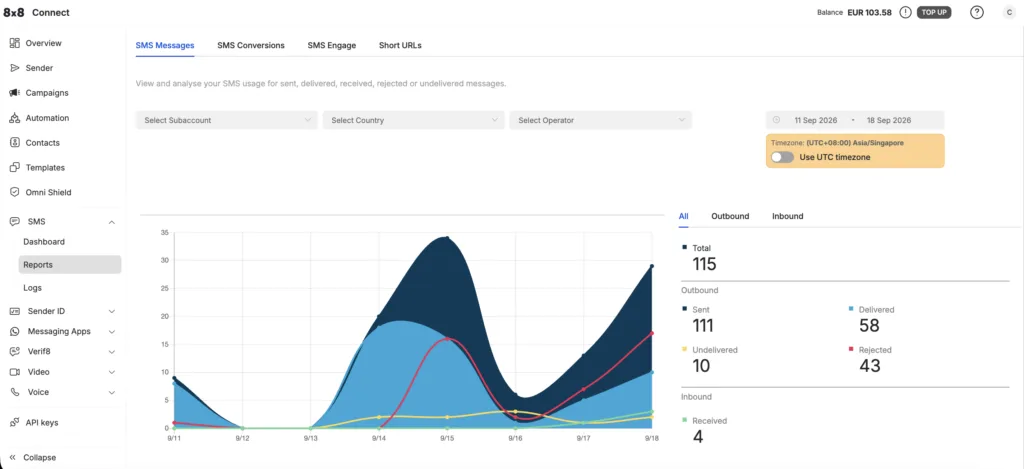
Decide which metrics you need to track before you send the campaign. Depending on your objective, these could include delivery rates, failed messages, link activity, conversions or opt-outs.
Monitoring should not stop once the SMS is sent. Delivery reports can help you identify problems quickly, while campaign data can help you refine your audience, messaging and timing for future campaigns.
Bulk SMS does not have to mean sending exactly the same message to everyone.
With 8×8 CPaaS, you can use its Batch API to send personalised bulk SMS, including shared or personalised content and properties. This allows you to combine the reach of a large-scale text blast with messaging that is more relevant to individual recipients.
The result is a campaign that can scale without treating your entire audience as one group.
See infographic: Top 5 Tips for Crafting SMS and WhatsApp Campaigns That Drive Customer Loyalty
What Are the SMS Marketing Regulations in Australia and Singapore?
If you are planning a bulk SMS marketing campaign in Australia, there are several regulatory requirements to consider before you hit send.
In Australia, the main areas to look at are the Spam Act 2003 (which covers consent, sender identification and unsubscribe requirements for commercial messages and is overseen by the ACMA) and the Privacy Act 1988, along with your own consent and opt-out processes. If your campaign also reaches Singapore mobile numbers, the Singapore requirements below also apply: PDPA, the Do Not Call (DNC) Registry, the Singapore SMS Sender ID Registry (SSIR), and your consent and opt-out processes.
What Do the PDPA and DNC Registry Require for SMS Marketing in Singapore?
The Personal Data Protection Act 2012 (PDPA) governs how organisations in Singapore collect, use and disclose personal data. Its Do Not Call (DNC) provisions cover certain marketing communications sent to Singapore telephone numbers, subject to applicable exceptions and requirements.
Before sending a marketing SMS, you should consider whether your campaign falls within the DNC regime and whether you have obtained the appropriate consent or can rely on an applicable exception.
But DNC compliance is not a substitute for good consent management. You should maintain records showing why a customer is eligible to receive a particular marketing communication and keep their communication preferences up to date.
You should also provide an appropriate way for recipients to stop receiving marketing messages and make sure withdrawal or opt-out requests are reflected in future campaigns.
What Is the Singapore SMS Sender ID Registry?
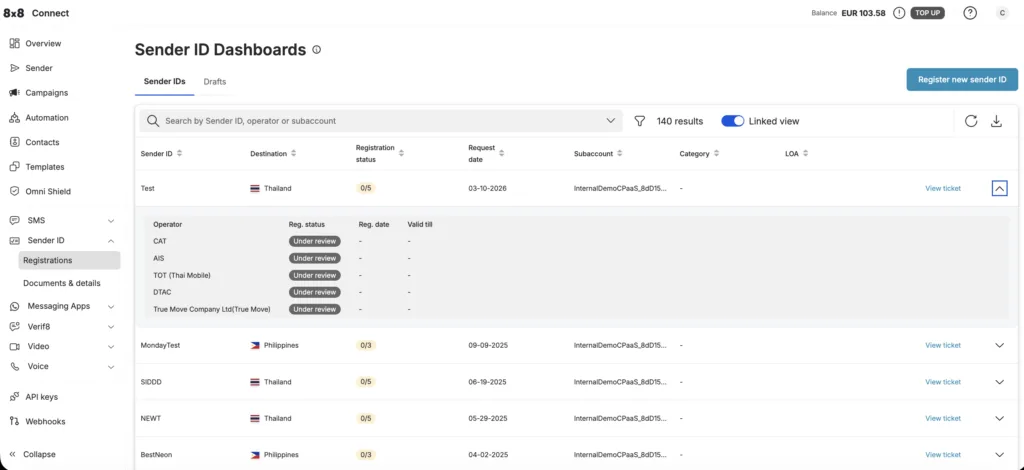
The Singapore SMS Sender ID Registry (SSIR) is the registry administered by the Infocomm Media Development Authority (IMDA) for organisations using Sender IDs for SMS messages sent to Singapore mobile numbers.
If you want your SMS to appear under an alphanumeric Sender ID, you need to follow the applicable SSIR requirements, including registration where required.
This means Sender ID management should be part of your campaign preparation from the start. It is not something to sort out after the campaign has already been sent.
Who Do These Requirements Apply To?
There is no single set of rules that applies to every SMS campaign. The requirements can depend on what you are sending, who you are contacting, who is sending the message and how it is being delivered.
For businesses sending SMS marketing in Singapore, the key considerations include:
- PDPA: How you collect, use and disclose customers’ personal data.
- DNC Registry: Whether your marketing communication falls within the DNC provisions.
- SSIR: Requirements for using alphanumeric SMS Sender IDs in Singapore.
- Consent and opt-out management: How you record customer consent, manage communication preferences and act on withdrawal or opt-out requests.
Check your audience, consent, message purpose and Sender ID before every campaign. Requirements can change and may depend on the specifics of your communication, so businesses should refer to the latest guidance from the Personal Data Protection Commission (PDPC) and IMDA when planning a text blast campaign in Singapore.
How Can Australian Businesses Handle SMS Opt-Outs?
If a customer no longer wants to receive your marketing messages, your SMS workflow needs to be aware and ensure that future campaigns respect that preference.
Your opt-out mechanism should be clear and, where applicable, included in the message itself. For example:
ABC Store: Enjoy 20% off this weekend. Shop now: [link]. To stop marketing messages, reply STOP.
The exact wording and opt-out method should be appropriate for your campaign and the applicable requirements.
But collecting an opt-out is only the first step. You also need to make sure that preference reaches the systems you use to manage your campaigns.
If a customer opts out today, removing them from one campaign list while leaving them on another does not solve the problem. Your CRM, customer database and SMS marketing platform should be able to recognise the customer’s updated preference before future campaigns are sent.
A central suppression or opt-out list can help prevent future marketing messages from being sent to customers who have withdrawn their consent or otherwise should not receive them.
For businesses running frequent or high-volume SMS campaigns, automating this process can reduce the risk of a customer opt-out being missed or manually overlooked.
How Much Does Bulk SMS Cost in Australia?
When comparing bulk SMS pricing in Australia, look beyond the headline cost per message. The cheapest rate on paper may not be the cheapest option once you factor in the other costs involved in running your campaign.
Consider:
- Cost per message
- Australia versus international destinations
- Minimum volume commitments
- API or platform fees
- Sender ID costs, where applicable
- Campaign management features
- Delivery reporting and analytics
- Technical and customer support
- Integration costs
For example, a provider with a lower per-message rate may not necessarily cost less overall if you also need to pay for separate campaign software, reporting tools or integration infrastructure.
The better comparison is the total cost of running your SMS campaign, not just the price of each message.
How Can 8×8 CPaaS Support Bulk SMS Campaigns in Australia?
8×8 CPaaS gives you the tools to plan, manage and monitor high-volume SMS campaigns, from sending messages at scale to tracking delivery and using campaign data to improve future communications.
With 8×8 Connect, your business can use a single, no-code omnichannel marketing platform to manage bulk SMS and voice campaigns, monitor real-time reporting and gain insights for campaign optimisation. The platform supports large-scale messaging and provides real-time reporting, helping teams monitor campaigns and optimise future communications.
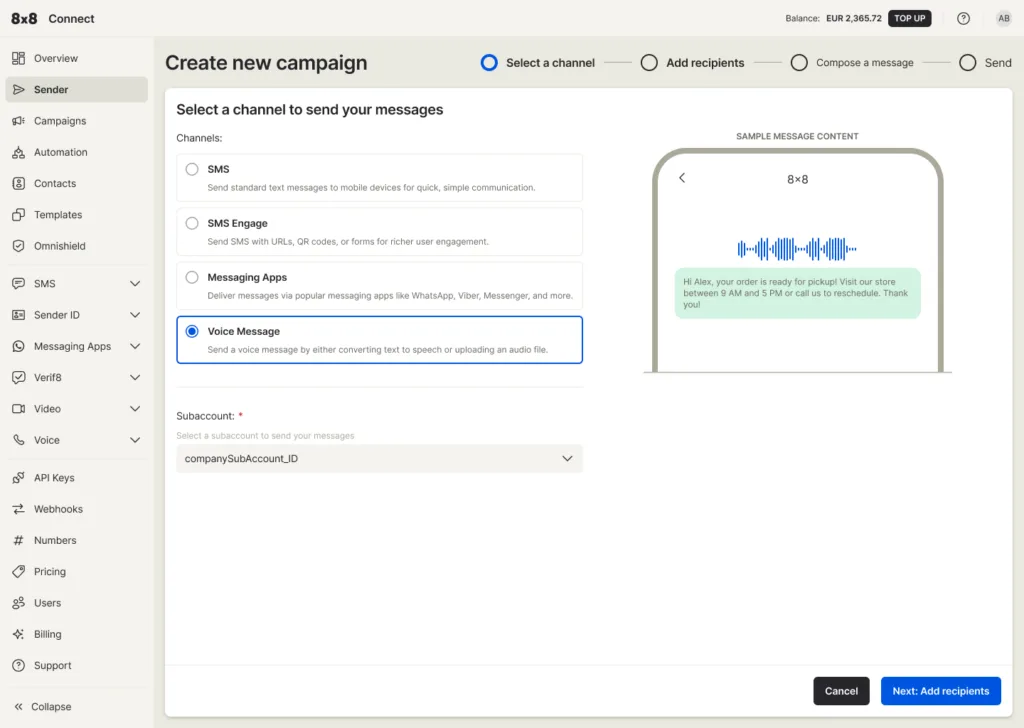
Key capabilities include:
- Streamlined multichannel management: Manage SMS, WhatsApp and voice campaigns across multiple channels from a single platform, reducing the need to work across separate systems.
- No-code system: Create and manage campaigns without requiring developer support, making it easier for marketing and customer engagement teams to launch and update campaigns.
- Campaign automation: Use the 8×8 Connect Automation Builder to create code-free communication workflows for reminders, notifications, customer support, surveys and other recurring interactions.
- Large-scale messaging: Send high-volume campaigns through one platform, supporting your business as your messaging needs grow.
- Real-time analytics: Monitor campaign activity and messaging performance with real-time reporting to identify trends and areas for optimisation.
For businesses running text blast campaigns in Australia, 8×8 CPaaS brings campaign management, messaging, automation and analytics together in one platform. This gives teams more control over high-volume sends while making it easier to turn campaign data and customer interactions into more informed future communications.
Talk to our experts to see how 8×8 CPaaS can help you plan, manage and scale bulk SMS campaigns with powerful messaging capabilities and real-time insights. Explore our pricing plans to find the right 8×8 CPaaS solution for your messaging requirements.
Frequently Asked Questions
- What is the difference between bulk SMS and SMS marketing?Bulk SMS describes the delivery of messages to a large number of recipients, while SMS marketing refers specifically to using SMS as a marketing channel. Bulk SMS can be used for both marketing and non-marketing communications, such as service announcements or event reminders.
- What should a bulk SMS marketing message include?A campaign message should clearly identify the sender, communicate the main value or information quickly and provide a clear call to action where appropriate. Marketing messages should also follow applicable consent, opt-out and regulatory requirements.
- How can Australian businesses measure SMS campaign performance?Businesses can monitor metrics such as delivery status, failed messages, engagement and campaign responses. Connecting SMS analytics with CRM or marketing systems can provide a broader view of how messaging contributes to customer actions and campaign outcomes.
- How can I let customers opt out of SMS marketing?Businesses should provide an appropriate mechanism for customers to stop receiving marketing communications and ensure opt-out requests are reflected in future campaign lists. A central suppression process can help prevent customers who have opted out from being included in subsequent campaigns.
- How much does bulk SMS cost in Australia?Bulk SMS pricing varies by provider and can depend on factors including messaging volume, destination, routing and additional platform capabilities. Businesses should compare total campaign costs rather than evaluating providers solely on their advertised per-message rate.