A bank notification can be as simple as “Your transfer was successful” – or as important as an alert that prevents a customer from losing money to a scam. For digital banks and fintechs, customer messaging is therefore more than a communications channel. It is part of the customer experience, fraud response and broader security framework.
Singapore banks and fintechs should use SMS and WhatsApp according to the purpose and risk of each message, with stronger controls for sensitive, transactional and security-related communications. Monetary Authority of Singapore (MAS) guidance and Singapore’s broader anti-scam measures have increased the focus on secure customer communications. Meanwhile, channels such as SMS and WhatsApp continue to play important roles in notifications, alerts and customer support.
The challenge is finding the right balance: messages need to reach customers quickly and reliably, but they should also avoid exposing unnecessary sensitive information or creating opportunities for phishing and social engineering.
How Should Singapore Digital Banks and Fintechs Approach Customer Messaging?
The first step is to distinguish what each instance of fintech customer messaging aims to achieve.
A transaction confirmation, fraud alert, marketing promotion and customer-service conversation carry different levels of risk and require different messaging approaches.
| Message type | Example | Key consideration |
| Transaction notification | “Your PayNow transfer of $500 was successful.” | Timely delivery and clear transaction context |
| Fraud alert | “We detected unusual activity on your account.” | Speed, authenticity and clear next steps |
| Authentication | “Your verification code is 123456.” | Secure delivery and protection against phishing |
| Service update | “Your card has been dispatched.” | Useful information without unnecessary sensitive data |
| Customer support | “Your support request has been received.” | Two-way communication and consistent identity |
| Marketing | “Get rewarded when you make your next purchase.” | Consent, DNC and promotional messaging requirements |
This distinction matters because the safest channel and message format for one use case may not be appropriate for another.
A promotional message can focus on relevance and engagement, while fraud alerts, transaction notifications and authentication messages need to place greater emphasis on security, clarity and timely delivery.
For instance, a fraud alert SMS from a bank in Singapore should prioritise speed, clarity and customer action, helping customers quickly recognise suspicious activity and know where to report it.
What Fintech Customer Messaging is Considered MAS-Aligned?
“MAS-aligned” messaging does not refer to a specific template or set of approved wording. Instead, financial institutions need to consider the requirements that apply to the type of message, communication channel, and customer journey.
For digital banks and fintechs, this means looking beyond the content of the message itself. Security alerts and transaction notifications may be subject to financial-sector requirements, while SMS and WhatsApp communications can also fall under Singapore’s broader rules on sender identification, scams, data protection and marketing consent.
1. Security and transactional messaging
A security or transaction notification SMS should provide enough information for the customer to understand what happened and quickly identify activity they do not recognise.
This can include:
- Timely notifications: Customers should receive appropriate alerts for events such as new-device logins, digital-token activation, high-risk activities and outgoing transactions, where applicable.
- Avoiding phishing cues: Banks should avoid including clickable links or QR codes in SMS and email alerts to retail customers where prohibited under applicable anti-scam measures.
- Clear transaction information: Alerts should provide sufficient information for customers to recognise and identify transactions without unnecessarily exposing sensitive data.
- Accessible reporting and blocking: Customers should have clear ways to report suspected fraud and, where applicable, restrict or block access to their accounts.
- Alerts for changes to security information: Changes involving contact details, authentication credentials or security tokens should trigger appropriate customer notifications and controls.
The exact requirements depend on the type of financial institution and communication, so messaging should be designed as part of the institution’s broader fraud-prevention and authentication framework.
2. SMS, Sender IDs and IMDA requirements
MAS requirements are only one part of the picture. SMS sent to Singapore mobile users is also subject to IMDA’s anti-scam measures and the SMS Sender ID Registry (SSIR).
Businesses using alphanumeric Sender IDs for SMS need to register those Sender IDs under the SSIR and send messages through participating SMS aggregators. This is particularly important for banks and fintechs because a recognisable Sender ID helps customers distinguish legitimate communications from potential scams.
The SSIR sits alongside other anti-scam measures implemented by IMDA, including the treatment of unregistered Sender IDs and measures to detect and block scam messages.
3. WhatsApp and other messaging channels
The same principle applies when banks use WhatsApp or other digital channels. MAS does not provide a single messaging template for WhatsApp, but financial institutions still need to consider applicable financial-sector, data-protection, anti-scam and platform requirements.
For WhatsApp specifically, businesses also need to follow the relevant WhatsApp Business requirements around customer opt-in, approved messaging practices, and permitted use cases.
This means a bank should not simply replicate an SMS campaign on WhatsApp. The channel, customer consent, message type and security requirements all need to be considered.
4. Marketing messages
Promotional communications have a different set of considerations from security and transactional alerts.
Marketing content should be fair, balanced, and not misleading, particularly when communicating financial products where customers need to understand relevant features, risks and limitations.
Banks and fintechs should also consider:
- PDPA and Do Not Call (DNC) Registry requirements when sending promotional SMS or other direct marketing communications.
- Consent and opt-out mechanisms for marketing communications.
- MAS advertising and conduct requirements applicable to financial products and services.
- Platform-specific requirements when using WhatsApp or other messaging channels.
This distinction is important because a bank cannot necessarily apply the same messaging rules to a fraud alert and a promotional offer. The purpose of the message determines which regulatory and operational requirements need to be considered.
There is no single “MAS-approved” format for bank SMS or WhatsApp messages. Instead, compliant customer messaging requires financial institutions to consider the message purpose, channel, customer type and information being communicated.
For a typical Singapore digital bank or fintech, that can mean considering MAS and ABS requirements for financial-sector communications, IMDA’s SMS and anti-scam measures, SSIR registration for SMS Sender IDs, PDPA and DNC requirements for marketing, and WhatsApp’s own platform rules.
SMS vs WhatsApp for Transaction and Fraud Alerts in Fintech Customer Messaging
Both SMS and WhatsApp can play a role in financial customer communications, but they serve different purposes. SMS works on any mobile phone without a data connection or app install, which makes it well suited to concise, time-sensitive alerts. WhatsApp can support richer, two-way interactions when customers need more context or assistance. The choice should ultimately depend on the sensitivity of the information, the customer’s expected action and the institution’s security controls.
When SMS is the better fit
SMS is well suited to short, time-sensitive notifications where the priority is getting information to the customer quickly.
Common examples include:
- Transaction alerts: Notify customers when a payment or transfer has been completed.
- Fraud alerts: Flag potentially suspicious activity and tell customers where to verify it.
- Service notifications: Provide updates such as card delivery or account-status changes.
- Authentication: Deliver OTPs or verification messages where SMS remains an appropriate authentication method.
SMS is also an established communication channel for Singapore’s financial institutions. Under the MAS and IMDA Shared Responsibility Framework, telcos are recognised as supporting infrastructure providers for financial institutions. IMDA has worked closely with telcos to secure the SMS channel, an official channel adopted by financial institutions for digital banking, through measures such as the mandatory SMS Sender ID Registry and anti-scam filter.
That said, SMS should not be treated as inherently secure simply because it comes from a familiar Sender ID. Banks still need to minimise sensitive information, avoid creating phishing cues and direct customers to trusted channels for actions requiring stronger authentication.
When WhatsApp can add value
WhatsApp becomes particularly useful when a notification needs to become a conversation or guided customer journey.
For example, a digital bank or fintech could use WhatsApp to:
- Provide service or application updates.
- Respond to customer inquiries.
- Guide customers through structured workflows.
- Provide additional context around a notification.
- Connect customers with support teams.
- Send relevant messages to customers who have provided the appropriate opt-in for marketing communications.
The advantage is not simply richer formatting. WhatsApp can give customers a way to continue the interaction within the same channel, rather than receiving a notification and then having to find a separate way to contact the institution.
However, financial institutions should be careful about using conversational channels for sensitive actions. A WhatsApp notification can tell a customer that suspicious activity has occurred, for example, while the actual account review, authentication or transaction dispute can take place within the bank’s authenticated environment.
SMS vs WhatsApp: Which Should Banks and Fintechs Choose?
There does not need to be a single winner. A multi-channel approach can use each channel for the customer journeys it handles best.
| Use case | SMS | |
| Transaction notification | ✓ Strong fit for concise alerts | ✓ Useful where richer context is needed |
| Fraud alert | ✓ Fast, direct notification | ✓ Can support follow-up conversations |
| OTP delivery | ✓ Commonly used | Depends on the authentication setup |
| Customer support | Limited | ✓ Strong fit for two-way conversations |
| Rich content | Limited | ✓ Supports richer, interactive experiences |
| Guided workflows | Limited | ✓ Can support structured journeys |
| Marketing | Subject to applicable consent/DNC rules | Requires appropriate WhatsApp opt-in and platform compliance |
For high-risk fraud and transaction scenarios, the messaging channel should form only one part of the overall security journey. The notification itself should help customers recognise what happened and know where to go next, without asking them to disclose passwords, OTPs or other sensitive credentials.
For digital banks and fintechs in Singapore looking to connect these channels into a broader customer communication strategy, 8×8 CPaaS can support SMS and WhatsApp messaging through integrated communications workflows, allowing financial teams to use different channels according to the customer journey rather than managing each channel in isolation.
How Should Digital Banks and Fintechs Handle Sensitive Data in Customer SMS and WhatsApp Messaging?
Financial institutions should follow a data-minimisation approach: communicate what the customer needs to know without unnecessarily exposing sensitive information.
For SMS and WhatsApp, this can mean:
- Avoiding full account or card numbers.
- Avoiding passwords, PINs and authentication credentials.
- Limiting personally identifiable information to what is necessary.
- Avoiding unnecessary financial details in message previews.
- Directing customers to authenticated channels for sensitive actions.
- Reviewing what information could appear on a locked phone’s notification screen.
For example, instead of:
Your account 123456789 has received a transfer of $15,000 from John Tan at 2:43 pm.
A bank could use:
ABC Bank: A transfer of $15,000 has been credited to your account. Open the ABC Bank app to view the transaction details.
The second approach provides useful notification value while reducing unnecessary exposure of account and sender information.
Messaging can also reinforce anti-scam education. Banks can use consistent language to remind customers that legitimate staff will never ask for passwords, OTPs or other authentication credentials.
However, messaging itself needs to be designed carefully. A security alert containing an unfamiliar link or asking customers to provide sensitive information could look exactly like the scams the bank is warning them about.
The safest customer messaging strategy is therefore one that makes legitimate communications predictable and suspicious requests easy to identify.
How Can Digital Banks and Fintechs Build a Secure Messaging Strategy?
A practical approach is to map each customer communication to its purpose, sensitivity and required customer action.
- Classify the message
Determine whether it is transactional, security-related, service-related, authentication-related or promotional. - Assess the information involved
Identify whether the message contains personal, financial or authentication information and whether all of it is necessary. - Select the appropriate channel
Consider whether SMS, WhatsApp, in-app notifications, or another channel is most appropriate for the use case. - Define the customer action
If customers need to respond, make a payment, verify their identity or report fraud, direct them towards a trusted and appropriately authenticated channel. - Build consistent messaging
Use recognisable sender identities, predictable language and consistent instructions across customer communications. - Monitor delivery and engagement
Track delivery outcomes and customer interactions so communication problems can be identified and messaging journeys improved. - Review regulatory and security requirements
Consider applicable MAS guidance, PDPA obligations, DNC requirements and platform-specific rules when designing the messaging workflow.
For financial institutions operating at scale, these processes are easier to manage when messaging infrastructure connects directly with the systems responsible for customer data, transactions, authentication and support.
How 8×8 CPaaS Supports Digital Banks and Fintechs in Customer Messaging
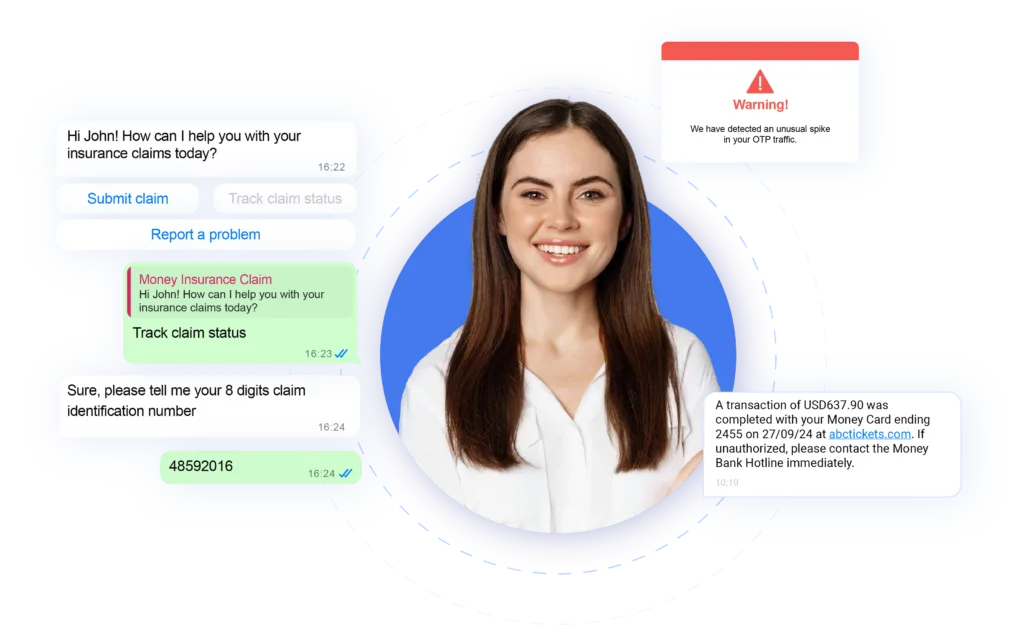
For financial institutions, customer communications need to be fast, secure and connected to the systems behind each interaction. 8×8 CPaaS provides solutions for the finance sector that bring messaging, authentication and customer identity capabilities together, helping banks and fintechs support everything from transaction alerts and fraud notifications to customer engagement and secure authentication.
8×8’s Omnichannel Messaging enables banks and fintechs to use WhatsApp, SMS, and other channels for richer, two-way customer communications, with support for notifications, interactive messaging, customer service and authentication use cases.
Financial institutions can use it to:
- Engage customers across channels: Use SMS, WhatsApp, voice and more to reach customers through the channels that fit different communication needs, from time-sensitive alerts to two-way customer service.
- Support richer customer conversations: Use WhatsApp for two-way messaging, interactive content and structured customer journeys, including WhatsApp Flows.
- Connect with existing systems: Integrate communications with CRM and support platforms such as Salesforce, Zendesk and Freshdesk, as well as other backend systems.
- Monitor messaging performance: Use analytics and reporting to track campaign and engagement activity across customer communications.
- Support authentication: Use messaging as part of appropriate verification and authentication workflows.
Customer messaging is only one part of a secure digital banking journey. Financial institutions also need to manage how customers authenticate themselves, access applications and verify their identity.
Talk to our experts to explore how 8×8 CPaaS can help digital banks and fintechs build secure, compliant customer messaging across SMS and WhatsApp.