A customer opens a web chat to fix a billing error, the bot stalls, and the conversation gets handed off to a phone agent.
She explains the whole problem again, because the agent can’t see a single line of the chat she just finished.
By the time it’s resolved, she has repeated the same story to two systems and one person, and that is where engagement breaks down.
Customers don’t care which channel they used first. What they care about is whether the business remembers the conversation and resolves it without making them repeat themselves.
That gap, between the channels you offer and the context you actually keep, is what a real customer engagement strategy has to close.
AI doesn’t replace your agents. It makes sure they never start a conversation blind.
Why AI Customer Engagement Strategies Stall After Pilots
Most teams aren’t short on AI ambition, but they’re stuck between a pilot that demos well and a system customers actually feel.
McKinsey found that 62% of organisations are at least experimenting with AI agents, while only 23% are scaling one in even a single business function.
The blocker usually isn’t the model. It’s the disconnect underneath it.
A bot that lives on a single channel, with no view of phone, email, or past chats, can answer a question but never hold a conversation.
So it shines in a demo and then stalls in production, because real customers switch channels constantly and rarely ask one tidy question.
A strategy that actually works fixes that disconnect first, then layers AI on top of conversations that are already connected.
How AI Closes the Conversation Gap Across Channels
Closing the gap is less about smarter replies and more about shared context, where every channel reads from the same conversation.
That shared context is what a platform like 8×8 Converse – an omnichannel engagement platform that unifies SMS, WhatsApp, and web chat into one workspace – is built to hold.
When a question arrives on WhatsApp, SMS, or web chat, AI reads the intent and the language before anyone is even assigned.
From there, it routes simple requests to a bot and complex ones to the right agent, and the full history travels with the conversation.
So when a bot hands it off, the agent opens a chat already in progress, with no “can you confirm your account number again.”
Compare that to a scripted bot, which matches keywords, misses intent, and dumps the customer onto an agent with no context at all.
The AI-assisted version routes faster, keeps the thread intact, and spares the customer from re-explaining anything. That is the difference customers feel.
Read More: AI Chatbots for Customer Service
What APAC Teams Need From Omnichannel Engagement
Shared context is harder to hold the more channels you run, which is exactly the position APAC teams start from.
Channel mix in Asia-Pacific (APAC) isn’t one thing, it shifts market by market, and a single default channel simply won’t reach everyone.
WhatsApp leads in Indonesia, Malaysia, and Singapore, while Viber dominates the Philippines, LINE rules Thailand, and Zalo owns Vietnam.
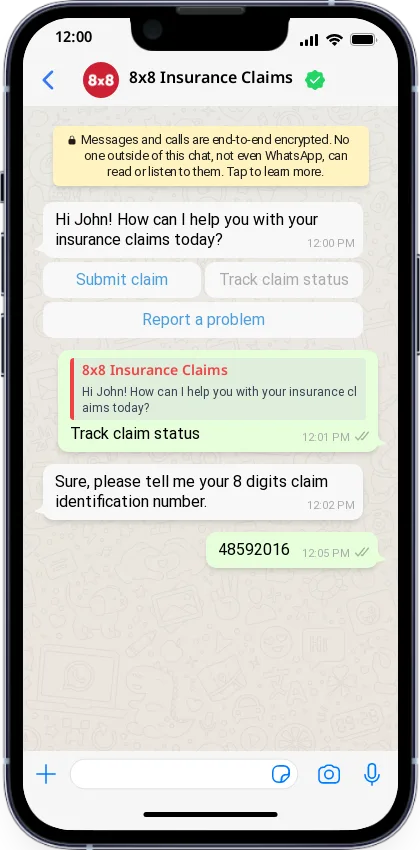
Customers across these markets are mobile-first, so they expect a fast reply in the app they already use, not a redirect to email.
That puts two demands on any engagement strategy: cover the right apps in each market, and handle handoffs across languages without losing the thread.
A customer might open in Bahasa on WhatsApp and then switch to English with an agent, so the context has to follow, language included. In Singapore, that same shift is just as likely to happen in Mandarin on WhatsApp before a handoff to an English-speaking agent, and the thread still has to carry the language and the history together.
8×8 Converse routes on detected language and intent at the same time, so the agent who picks the conversation up is the right one on both counts, and the thread arrives with them.
Regional teams feel this the most, because running a separate tool for every channel multiplies cost and fractures context, while one platform does the opposite.
It matters in regulated sectors too, where APAC finance teams juggle high message volumes and strict identity rules across the very same channels. In Singapore, a bank like DBS or OCBC – or a telco like Singtel – runs exactly this pattern: a PayNow query on WhatsApp, a call to the contact centre, and a web chat about the same transaction, all needing to resolve as one conversation under MAS’s identity-verification rules.
Read More: Customer Communication Management Across Every Channel
Personalisation That Keeps Context, Not Just Names
Personalisation used to mean dropping a first name into a subject line, but that bar disappeared a long time ago.
Real personalisation is different. It remembers what happened last time, so it knows the open ticket, the recent order, and the channel a customer prefers.
AI makes that practical at scale, adjusting tone, surfacing the right answer, and flagging an at-risk account in the middle of a conversation.
In practice, it looks like this: A customer messages about a late order, and the agent opens a thread that already shows the order number, the delivery exception, the credit promised last week, and the fact that this customer always replies after 8 pm.
Nobody asked for any of it. It was attached to the conversation before the agent arrived, and that is the whole difference between personalisation and a merge field.
The shift is already underway. Gartner expects 40% of enterprise applications to carry task-specific AI agents by the end of 2026, up from under 5% in 2025.
AI does more than answer: it routes the harder cases to a human with the full context already attached.
Measuring AI Engagement ROI Beyond Chatbot Deflection
Deflection rate alone is a common but incomplete metric – it ignores whether the customer was actually helped, and a resolved issue is not the same outcome as a dodged one.
Stronger signals tie engagement to real results, such as first-contact resolution (FCR), customer satisfaction (CSAT), and conversion rate from chat.
The return shows up once the workflow is connected: IDC, in a study Microsoft commissioned, puts the average return on generative AI at 3.7 times every dollar invested.
Centralising engagement data across channels is what makes those numbers visible, since you can’t optimise what each siloed tool measures on its own.
How 8×8 Converse Connects AI, Agents, and Messaging
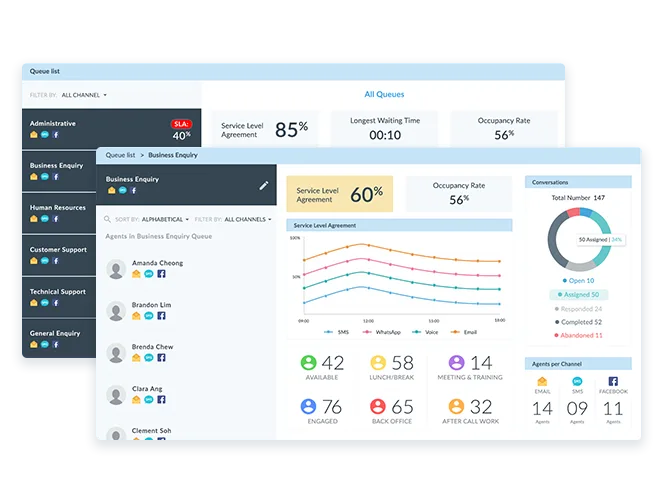
This is the gap 8×8 Converse is built to close, bringing SMS, WhatsApp, Viber, and web chat into one workspace where AI handles the routing and agents handle the conversation.

An inquiry arrives on WhatsApp in Bahasa. Converse reads the intent and the language, then puts it in front of an agent who handles both.
That agent opens one thread, not four tabs. The customer profile, the earlier SMS, and the web chat from Tuesday are already in it.
Underneath it all, omnichannel messaging routes each conversation by intent, language, and history, so the right resource picks it up the first time.
For teams scaling support across markets, customer support solutions like this replace a patchwork of channel tools with one connected workflow.
That is how a pilot finally becomes production, not through a bigger bot, but through connected conversations that agents and AI share.
It’s the same approach 8×8 uses to tie AI and automation into live agent handoffs that run across every channel.
Build a Customer Engagement Strategy Customers Can Feel
Your competitors are already using AI to handle routine inquiries, so the question isn’t whether to invest; it’s how fast you can move from pilot to production.
Every week the pilot stays in testing is another week of customers telling that story twice, to two systems and one person, and remembering how it felt.
Talk to 8×8 about turning fragmented channels into one connected conversation today, or find out more about 8×8 Converse.
FAQ – Customer Engagement Strategy
- What is a customer engagement strategy? It’s a planned approach to interacting with customers across every channel, keeping context and personalisation consistent so issues get resolved without repetition.
- How does AI improve customer engagement? AI reads intent and language, routes each conversation to the right bot or agent, and carries full history into human handoffs so customers never repeat themselves.
- Why do AI engagement pilots fail to scale? Most pilots run on a single channel with no shared context, so they can answer questions but can’t hold a conversation across phone, chat, and messaging apps.
- Which channels should an APAC engagement strategy cover? It depends on the market, with WhatsApp strong in Indonesia and Singapore, Viber in the Philippines, LINE in Thailand, and Zalo in Vietnam, plus handoffs that hold across languages.
- How do you measure AI customer engagement ROI? Look past deflection to first-contact resolution, CSAT, and conversion from chat, all measured on centralised data across every channel.