Choosing a CPaaS provider for Australia involves more than comparing SMS rates. Consider how well each provider supports local messaging requirements, verification, WhatsApp and other channels, APIs and integrations, fraud prevention, customer support and expansion into other APAC markets.
Four providers commonly considered for these requirements are 8×8 CPaaS, Sinch, Vonage and Infobip. All four offer programmable communications, but their product portfolios and strengths differ across messaging, voice, video, verification, omnichannel engagement and network intelligence.
For an Australia-based business, the right fit depends on your use case, target markets and technical requirements. Local deliverability, Sender ID compliance, channel availability, API capabilities, and APAC coverage can all affect the decision.
How Do I Compare CPaaS Providers in Australia?
Before comparing individual providers, look at the capabilities that will affect your actual communications workflows.
1. Messaging channels
Start with the channels your customers already use and the ones you expect to add.
For example, an Australian business may need SMS for transactional notifications and OTPs, WhatsApp for customer conversations, and voice as a fallback or escalation channel. An APAC expansion may also introduce channels such as LINE or Zalo.
2. OTP and verification
If you are using CPaaS for authentication, consider more than SMS OTP.
Look at:
- SMS, voice and WhatsApp verification
- Email and RCS verification where supported
- Silent authentication or data verification
- Flash Call
- Automatic channel fallback
- Number intelligence
- SIM-swap detection
- Traffic-pumping and SMS-fraud controls
- Verification analytics
3. Australia’s SMS Sender ID Register and compliance
Australia’s Sender ID requirements should be part of the initial vendor assessment, not something you address after choosing a provider. Under the Telecommunications (SMS Sender ID Register) Industry Standard 2025, ACMA’s SMS Sender ID Register becomes mandatory from 1 July 2026 – businesses that have not registered an alphanumeric Sender ID risk having their messages labelled “Unverified” to recipients. Commercial SMS also needs to meet the consent, identification and unsubscribe requirements of the Spam Act 2003, enforced by ACMA.
Check how each provider supports Sender ID registration, provisioning and troubleshooting, including who manages the registration process and what support is available if traffic is blocked or a Sender ID is not recognised.
4. APAC coverage
A provider’s global country count is useful, but it does not tell you everything about a specific APAC market.
For each country you plan to enter, check factors including SMS availability, local carrier connectivity, verification methods, and data and privacy requirements.
5. APIs, SDKs and integrations
Your technical team should assess the actual development experience, not just the number of APIs listed on a product page.
Look at API documentation, SDKs, webhooks, developer tools, integration options and how easily your existing applications and systems can connect to the provider.
6. Fraud prevention
For high-volume messaging and verification, fraud protection deserves its own assessment.
Ask providers how they detect and respond to threats like SMS pumping, SIM-swap risks, invalid or unreachable numbers, and suspicious traffic patterns.
7. Support and onboarding
A technically capable API is only part of the implementation.
For Australia and APAC deployments, ask about local support, account management, implementation assistance, escalation routes and service-level commitments.
Australia CPaaS Providers Compared: Services, Features and Security
-
8×8 CPaaS
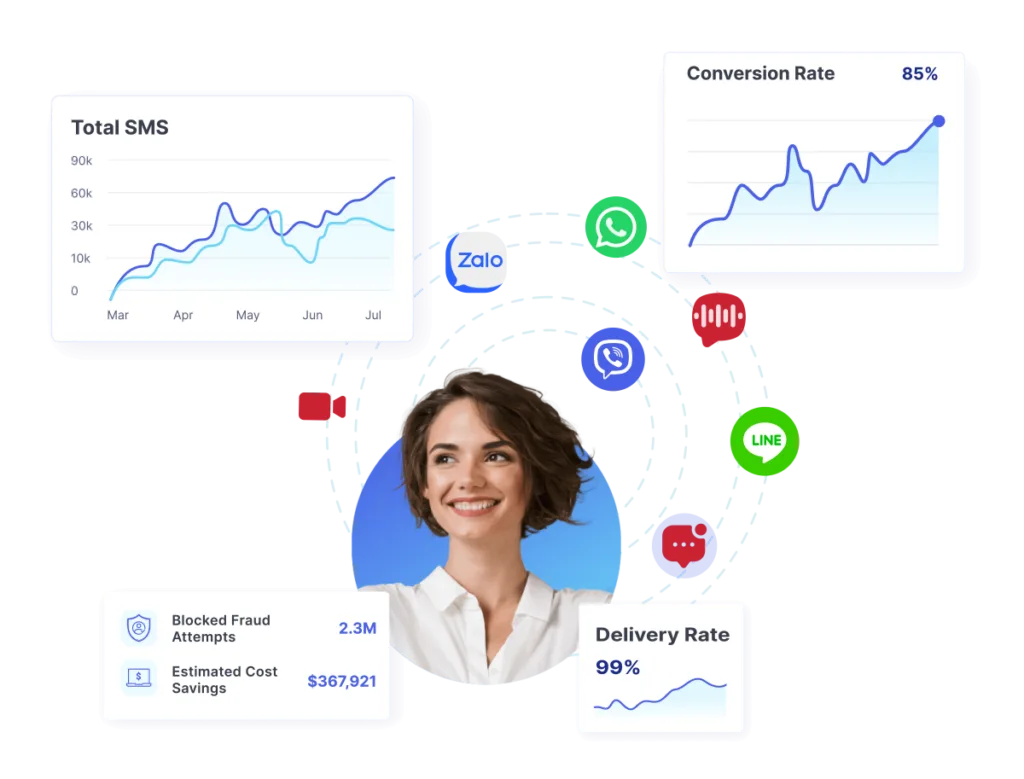
One platform, every channel with 8×8 – WhatsApp, Zalo, LINE, Viber, voice and video. 8×8 CPaaS gives businesses a way to build programmable communications into their applications and customer journeys. Its offering covers SMS, voice, video, WhatsApp and other messaging channels, alongside verification, fraud protection and tools for managing customer conversations.
For businesses in Australia, that means you can use 8×8 CPaaS for everything from transactional SMS and OTPs to two-way WhatsApp conversations and automated customer notifications. If you are expanding across APAC, the same platform can also support communications across multiple markets and channels.
SMS and messaging APIs
The 8×8 CPaaS SMS API lets you send SMS directly from your applications. You can use it for transactional messages, notifications, alerts, campaigns and other application-triggered communications.
It also supports inbound SMS, allowing you to receive replies through a webhook rather than treating SMS as a one-way channel.
This makes the SMS API useful when you need messaging to happen automatically, for example, sending an order update after a purchase or an OTP when a customer signs in.
WhatsApp and omnichannel messaging
Beyond SMS, 8×8 supports channels including WhatsApp, RCS, Viber, Zalo and LINE, with additional channels available through its broader communications products.
WhatsApp can be used for both business messaging and customer conversations, while WhatsApp Business Calling is also available through Converse.
This gives businesses more options when SMS is not the best channel for the interaction – whether that means sending a richer notification, continuing a customer conversation or giving customers another way to contact your team.
OTP and user verification
The 8×8 CPaaS Verification API is designed for applications that need to verify users during sign-ups, logins, account recovery or transactions.
You can send verification codes through SMS, WhatsApp, Viber or voice, giving you different options when a customer does not receive or cannot use their first-choice channel.
8×8 also supports Silent Mobile Authentication, which verifies eligible users through their mobile devices, helping reduce friction while strengthening authentication against risks such as phishing and account takeover.
Voice and video
8×8 also extends beyond messaging with programmable voice and video capabilities.
Its voice API can support use cases such as programmable calls, virtual numbers, call flows and IVR. This can be useful when a customer journey needs more than a text message, for example, offering a voice fallback when an SMS OTP is not received.
For video, Video Interaction allows a business to send an SMS invitation that opens a browser-based video session. Customers do not need to download a separate app, which can make video support easier to add to an existing customer journey. For businesses that need video embedded directly into their own app rather than opened from an SMS link, Jitsi as a Service (JaaS) offers a cloud-native video SDK that can be built into existing web and mobile experiences, with options like recording, RTMP streaming, and branded UI.
Fraud protection
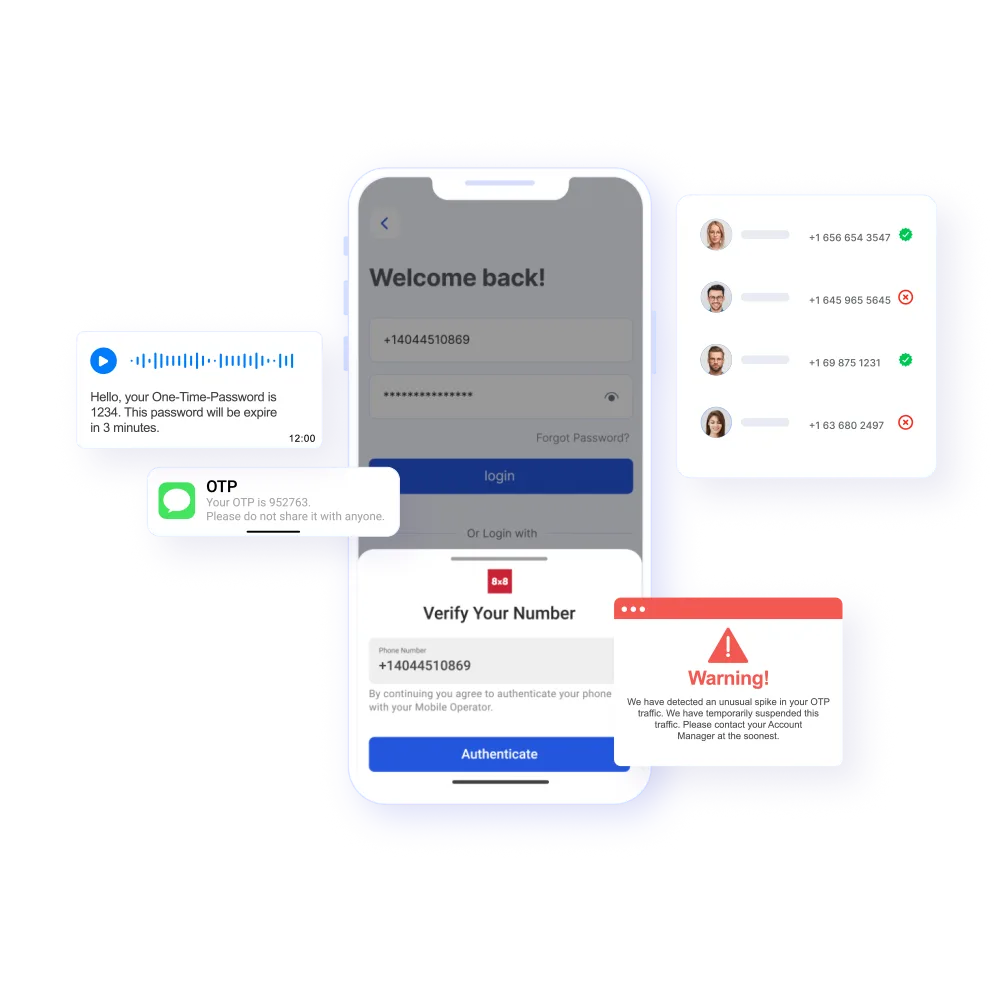
The same login flow that sends an OTP by voice or WhatsApp also watches for the pattern that signals fraud – an unusual spike in verification traffic triggers an automatic warning before it becomes a cost problem. 8×8 CPaas takes a broad approach to protecting messaging, verification and identity workflows, with solutions covering different stages of the customer journey:
- Omni Shield – Monitors messaging and verification traffic for suspicious patterns and helps detect and prevent fraud such as SMS pumping, toll fraud and artificially inflated traffic. During early-stage deployments, Omni Shield identified more than 85% of fraudulent SMS traffic while maintaining reliable message delivery for authorised communications.
- Mobile Verification – Supports OTP generation and validation across SMS, voice and messaging channels, with Sender ID management, channel orchestration, automatic voice fallback and visibility into delivery, conversion and fraud performance.
- Number Lookup– Provides real-time phone number insights, including validity, activity, carrier and location information, helping businesses improve routing, reduce failed attempts and avoid unnecessary messaging costs.
- Descope CIAM – Adds authentication, authorisation and identity management within applications, with tools such as risk-based MFA, step-up authentication and passkeys to help businesses strengthen identity controls.
Together, these solutions work to protect against fraud across the customer journey.
8×8 Connect and 8×8 Converse
These two platforms serve different parts of the communications workflow.
8×8 Connect is a no-code platform focused on outbound campaigns. Teams can use it to manage messaging and voice campaigns, templates, services and reporting, while APIs and automation tools connect those communications to applications and customer journeys.
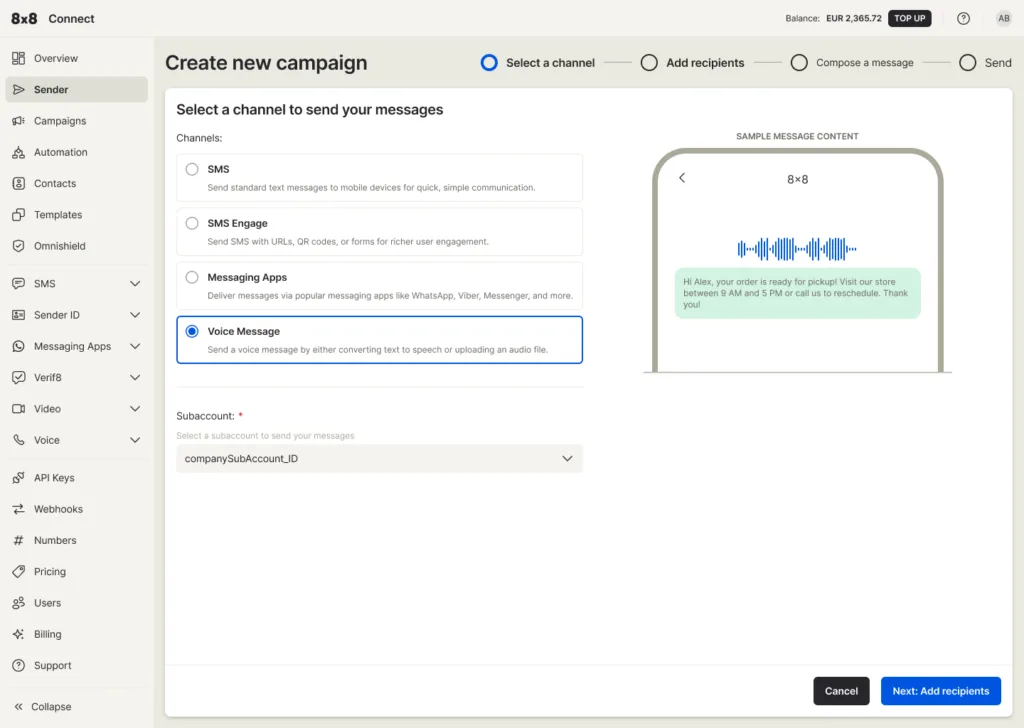
Send omnichannel campaigns with 8×8 Connect – SMS, Messaging Apps, or voice, with a live preview of what the customer will see. 8×8 Converse is focused on two-way conversations. It brings WhatsApp, SMS, voice, email, web chat and other channels into one workspace, allowing agents to manage two-way customer interactions without switching between separate tools.

Move a conversation from WhatsApp chat to a WhatsApp Call without the agent losing the thread on 8×8 Converse. Developer support
8×8 provides API documentation, developer resources and SDKs to support integrations across its communications services. Its APIs can be managed through 8×8 Connect, with tools for API keys, messaging and other programmable communications.
In 2025, 8×8 CPaaS was named Best CPaaS Platform at the CX Awards, with judges highlighting its composability, embedded AI and ability to bring internal and external communications together on a modular platform.
The following year, 8×8 was named a MetriStar Top Provider for CPaaS by Metrigy, and also received the Top Provider recognition for Contact Center as a Service (CCaaS). The company scored above average on both business success and customer sentiment, with particular strength in platform reliability and no-code and low-code application quality.
-
Sinch
Sinch is a global communications platform offering APIs for messaging, verification, voice, video and email, alongside tools for customer engagement and contact centres.
For businesses operating in Australia and expanding across APAC, Sinch covers use cases such as transactional SMS, OTP verification, customer notifications and two-way messaging.
SMS and messaging APIs
Sinch provides APIs for sending programmable messages, including SMS and other messaging channels. You can integrate messaging into applications for notifications, alerts, authentication and customer communications.
For businesses that need more control over how messages are delivered, Sinch also provides connectivity and routing capabilities through its wider communications network. Sinch’s communications portfolio also extends into email, with separate products for no-code and code-heavy use.
Conversation API
Sinch Conversation API provides a single integration for communicating across multiple messaging channels. It supports SMS, RCS, WhatsApp, LINE, Telegram, Instagram, Facebook Messenger, Viber and other channels, with availability and capabilities varying by market.
Instead of building a separate integration for every messaging channel, you can work with a common API structure and configure the channels you need.
It supports both one-way and two-way messaging, making it useful for customer notifications, service, and engagement.
Sinch Verify
Sinch Verify is Sinch’s dedicated verification solution for businesses that need to confirm a user’s phone number during sign-ups, logins, account recovery and other authentication flows.
It supports several verification methods, including SMS, voice, Flashcall and data verification, giving businesses alternatives when a standard SMS OTP is not the best fit.
Sinch Verify also supports REST APIs and SDKs for iOS and Android, so developers can integrate verification into both web and mobile applications.
Fraud protection
Sinch provides authentication controls around its verification APIs to help prevent unauthorised verification requests from generating traffic. This is relevant to Artificial Inflation of Traffic (AIT), where fraudulent requests can drive up SMS or voice traffic and associated costs.
Sinch also offers fraud and number intelligence capabilities across its broader communications portfolio, including tools designed to identify risks such as traffic pumping and SIM-swap activity.
Developer support
Sinch provides API documentation, SDKs and developer tools across messaging, verification, voice and other communications services. Its developer portal includes API references, guides and code samples to support implementation and testing.
-
Vonage
Vonage provides communications APIs for businesses that want to add messaging, voice, video and verification to their applications and customer journeys. Its APIs cover channels including SMS, RCS, WhatsApp, email and voice, alongside programmable voice and video capabilities.
For businesses operating in Australia and expanding across APAC, Vonage can support use cases ranging from transactional SMS and OTP verification to WhatsApp messaging, programmable calling and video.
SMS and messaging APIs
Vonage provides APIs for sending and receiving SMS, as well as messaging through channels such as WhatsApp, Facebook Messenger, and RCS.
The Vonage Messages API provides a common way to build messaging into applications across supported channels. This can be used for transactional notifications, customer communications, alerts and two-way messaging.
Voice and video APIs
Beyond messaging, Vonage provides a programmable Voice API that lets businesses build calling into their applications, with Automatic Speech Recognition in 120 languages.
Use cases can include automated calls, IVR, call control and other application-driven voice interactions. This can be useful when a customer journey needs a voice option alongside SMS or messaging.
Vonage also provides a Video API for adding real-time video capabilities to applications.
This feature supports video consultations, remote assistance, virtual appointments and other situations where customers need to interact with a person rather than simply receive a message.
Vonage Verify
Vonage Verify is the platform’s dedicated solution for phone number verification and two-factor authentication.
It allows businesses to verify users through SMS, voice, WhatsApp, RCS, email and Silent Authentication, with workflows that determine which channels are used and in what order.
Additionally, their Number Insight service can identify whether a number is valid, reachable, virtual or a landline, while SIM Swap Insight provides additional security by detecting if the SIM card linked to a given phone number has recently changed.
Fraud protection
Fraud prevention is built into Vonage Verify through Fraud Defender, which is designed to detect and block Artificially Inflated Traffic (AIT).
Fraud Defender is included with Verify at no additional cost, providing customisable controls for different markets and accounts, and SMS burst protection, which caps the number of text messages sent to a specific country or destination within a short window, like 10 minutes, to stop fraud.
Developer support
Vonage has an established developer platform covering its messaging, voice, video and verification APIs. Developers can access API references, SDKs, code samples, tutorials and tools for testing integrations.
-
Infobip
Infobip is a global communications platform that combines messaging APIs with tools for customer engagement, verification, chatbots and contact centres. Its platform covers channels including SMS, WhatsApp, RCS, voice, email and other messaging apps, with APIs and no-code or low-code tools for different levels of technical involvement.
For businesses in Australia and across APAC, Infobip can support use cases ranging from transactional SMS and OTP verification to WhatsApp conversations, marketing campaigns and broader customer engagement.
SMS API
Infobip’s SMS API lets businesses send and receive programmable SMS for transactional messages, notifications, authentication and campaigns.
You can use it for individual messages or larger messaging programmes, with features such as delivery reports, scheduling and inbound messaging. Infobip also provides SDKs and developer tools for integrating messaging into applications.
WhatsApp and rich messaging
Infobip supports WhatsApp Business messaging alongside other rich messaging channels such as RCS.
These channels can be used for more interactive customer journeys than traditional SMS. A business might use SMS for a simple notification, then use WhatsApp for a conversation that requires richer content or a customer response.
Infobip also supports features such as chatbots and conversational messaging, allowing businesses to build automated interactions before handing conversations over to a human agent where needed.
Customer data platform
Infobip also offers an AI-powered customer data platform (CDP) that brings customer interactions and behavioural data into unified, real-time profiles.
Infobip also has an AI-powered customer data platform that brings customer interactions and behavioural data into real-time customer profiles. Businesses can use behavioural events and other data sources to create AI-driven segments and activate personalised engagement across WhatsApp, RCS, SMS and other channels.
Verification
Infobip’s authentication tools include its 2FA API support for one-time passwords (OTPs) through channels such as SMS and voice, with options to customise the verification experience and manage the authentication flow.
Infobip also offers mobile identity verification, which can verify a user’s mobile number through network-based methods rather than relying solely on an SMS OTP.
Fraud protection
Infobip’s authentication stack includes several tools for detecting and preventing fraudulent activity. Signals monitors OTP traffic for suspicious patterns, assigns risk scores to destinations and can automatically block traffic that exceeds configured thresholds.
Infobip also offers SIM Swap Detection and Number Intelligence through its Mobile Identity platform. These tools can provide real-time information about SIM changes and other subscriber attributes, allowing businesses to add additional checks before authenticating a user or approving a sensitive action.
Developer support
Infobip provides API documentation, SDKs and developer resources covering its messaging, authentication and communications services. Its developer platform also includes an API hub, guides and tools to help teams build and test integrations.
| Provider | Messaging | Verification & identity | Voice & video | Fraud & security | Customer engagement | Developer support |
| 8×8 CPaaS | SMS, WhatsApp, RCS, Viber, Zalo, LINE; inbound SMS and two-way messaging | Verification API, SMS/WhatsApp/Viber/voice OTP, Silent Mobile Authentication, Mobile Verification, Number Lookup | Programmable voice, virtual numbers, Voice API, Video Interaction, Jitsi as a Service | Omni Shield, Mobile Verification, Number Lookup, Descope CIAM | 8×8 Connect for outbound campaigns; 8×8 Converse for two-way customer conversations | APIs, SDKs, developer documentation, API keys and webhooks |
| Sinch | SMS, RCS, WhatsApp, LINE, Telegram, Instagram, Facebook Messenger, Viber and other channels; Conversation API | Sinch Verify, SMS/voice/Flashcall/data verification, REST APIs and iOS/Android SDKs | Programmable voice and video | Verification controls for AIT; fraud and number intelligence; traffic pumping and SIM-swap protection | Conversation API and broader customer engagement tools | APIs, SDKs, API references, guides and code samples |
| Vonage | SMS, WhatsApp, Facebook Messenger, RCS and other supported messaging channels; Messages API | Vonage Verify, SMS/voice/WhatsApp/RCS/email/Silent Authentication; Number Insight and SIM Swap Insight | Voice API, IVR, call control, ASR; Video API | Fraud Defender, AIT detection/blocking, SMS burst protection | Messaging APIs and programmable communications for customer journeys | APIs, SDKs, API references, code samples, tutorials and testing tools |
| Infobip | SMS, WhatsApp, RCS and other messaging channels; inbound messaging, scheduling and delivery reports | 2FA API, SMS/voice OTP, mobile identity verification | Voice and broader communications capabilities | Signals, SIM Swap Detection, Number Intelligence, OTP traffic monitoring and risk scoring | AI-powered CDP, chatbots, conversational messaging and contact centre tools | APIs, SDKs, API hub, guides and integration/testing tools |
CPaaS Providers in Australia & APAC: Coverage & Support
If your Australian business is expanding across APAC, country coverage is only part of the picture when selecting a CPaaS provider. Local carrier relationships, channel availability, onboarding and support can all affect how easily you can launch and operate communications in each market.
-
8×8 CPaaS
8×8 CPaaS supports 160+ direct mobile network operators in more than 190 countries, with Singapore as its primary data centre, delivering reliable, low-latency performance across the entire region.
Onboarding
8×8 CPaaS has a dedicated Sender ID Self-Registration Module built into the 8×8 Connect Portal, designed to simplify Sender ID registration in regulated markets. Instead of handling registration through separate paperwork and email exchanges, businesses can submit and track applications through the portal.
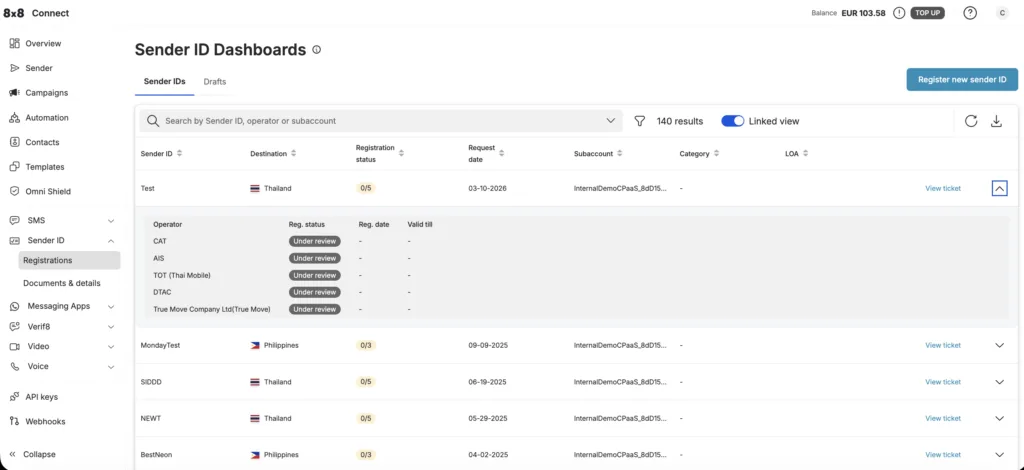
With 8×8, one dashboard tracks Sender ID registration across every destination and operator. The module can automatically generate the required Letter of Authorisation (LOA) based on the registration details, while a central dashboard lets you track the status of Sender ID applications by destination country or Sender ID. The self-registration workflow currently supports markets including Indonesia, Thailand and the Philippines.
Australia is not yet part of that self-registration workflow, so Australian businesses register and manage their own Sender ID directly with ACMA’s SMS Sender ID Register through their telco or provider. For Australian businesses expanding into Indonesia, Thailand or the Philippines, though, the module can make Sender ID onboarding more straightforward across those neighbouring APAC markets.
Support
8×8 offers a structured support model, tailored to meet the needs of small, growing, and enterprise-level businesses. Depending on the support tier, features include 24/7 availability, web and email support, and a line to a dedicated engineer. The highest support tiers offer a dedicated Customer Success Manager (CSM) and a Service Delivery Manager who oversees the day-to-day quality of your support experience.
-
Sinch
Sinch’s Super Network has 600+ direct carrier connections and provides access to 190+ countries. Sinch also has an APAC presence, including its APAC headquarters in Singapore.
Sinch provides an Alphanumeric Sender ID service, ensuring that your business stays compliant with the relevant regulations in Australia, Indonesia, and other APAC countries.
Additionally, the company’s specialists can assist you in configuring your project using the Sinch Build Dashboard or Customer Dashboard. This includes setting up API applications, authenticating senders, and configuring key APAC channels like WhatsApp, Facebook Messenger, and SMS.
-
Vonage
Vonage’s SMS API network spans over 1,600 direct-to-carrier and tier 1 connections globally, delivering high-reliability messaging across the Americas, Europe, APAC, and Africa.
This provider has a developer-focused platform with API documentation, guides and code examples, making it well-suited to teams that want to prototype and build integrations themselves.
Vonage’s support tiers range from Standard to Enterprise packages, encompassing an online knowledge base and standard communication channels, and expanding to include a Designated Support Engineer (DSE) and Customer Solutions Management (CSM) services.
Vonage documents Australia’s Spam Act 2003 consent and Sender ID requirements and provides guidance on registering a compliant Sender ID for Australian traffic, including the process for having registered Sender IDs whitelisted with Vonage.
-
Infobip
Infobip supports communications across 190+ countries, with 9,700+ global connections and 800+ direct operator connections. It also has a broad APAC presence, with offices across markets including Australia, China, India, Indonesia, Japan, Malaysia, the Philippines, Singapore, South Korea, Taiwan, Thailand and Vietnam.
Infobip offers professional services and onboarding packages covering implementation, project management and training, alongside CX consulting, migration services and custom integration. It also provides 24/7 technical support with coverage in more than 14 languages, plus dedicated support engineers and escalation paths.
| Provider | Global / APAC coverage | Australia / Sender ID Register | Onboarding | Support |
| 8×8 CPaaS | 190+ countries; 160+ direct MNOs; Singapore data centre | ACMA’s SMS Sender ID Register (mandatory from 1 July 2026) managed directly with your telco/provider; 8×8’s Self-Registration Module covers Indonesia, Thailand and the Philippines for regional expansion | Self-service Sender ID registration; Indonesia, Thailand and Philippines supported | 24/7 options, dedicated engineer; higher tiers include CSM and Service Delivery Manager |
| Sinch | 190+ countries; 600+ direct carrier connections; APAC HQ in Singapore | Alphanumeric Sender ID support for Australia and other APAC markets | Build Dashboard and Customer Dashboard for API, sender and channel setup | Enterprise support and specialist assistance |
| Vonage | 700+ direct carrier networks globally | Sender ID registration guidance for Australia (Spam Act 2003) and whitelisting | Developer-focused setup with APIs, documentation and guides | Standard to Enterprise support; DSE and CSM available on higher tiers |
| Infobip | 190+ countries; 9,700+ connections; 800+ direct operator connections; broad APAC presence | Broad APAC office presence including Australia; no Australia-specific Sender ID partnership announced | Professional services covering implementation, project management, training and integration | 24/7 support; 14+ languages; dedicated engine |
Key Takeaway
Each provider brings a slightly different focus to the CPaaS market, so the right fit depends on what matters most for your business:
- 8×8 CPaaS – Consider it if you’re looking for an Australia-focused option with transparent pricing, integrated communications and local support. It combines messaging, voice, video and verification capabilities, with tools designed to simplify onboarding and support communications across APAC markets.
- Sinch – Consider it if global messaging scale, carrier connectivity and verification are key priorities. Its broad communications platform covers messaging, verification, voice and other channels, making it suitable for businesses managing communications across multiple international markets.
- Vonage – Consider it if you’re building communications directly into applications and want a developer-focused platform. Its APIs cover messaging, voice, video and verification, giving development teams flexibility to build communications into existing products and customer journeys.
- Infobip – Consider it if you need a broader omnichannel platform that goes beyond communications APIs. Alongside messaging and verification, it brings customer engagement, data and orchestration capabilities into the same platform, which can be useful for larger customer communication programmes.
Ultimately, compare the providers based on your target markets, channels, integration requirements, support model and commercial terms, particularly if Australia or multiple APAC markets are part of your deployment.
8×8 CPaaS as Your Dedicated Provider in Australia and APAC
Choosing a CPaaS provider is only one part of the decision. You also need the infrastructure, integrations and support to put your messaging and verification workflows into practice.
8×8 CPaaS brings SMS, WhatsApp, voice, video and verification capabilities together, with APIs and enterprise integrations that connect communications to your existing systems.
With 8×8 CPaaS, your business can leverage:
- Fast onboarding – Get your messaging channels set up with expert onboarding support.
- Local, dedicated support – Work with a dedicated Account Manager and access 24/7 customer and technical support from local offices.
- Transparent pricing – Choose an all-inclusive monthly fee with a one-time setup fee, with no additional fees for subsequent template setup.
- Enterprise integrations – Connect APIs, SDKs and webhooks with your existing contact centre, CRM and other business systems.
- Scalable infrastructure – Support growing messaging volumes with high availability, adaptable architecture and global reach.
- Reliable network quality: 8×8 runs its own end-to-end network with direct carrier connections, giving you tight control over routing, quality and uptime for dependable, low-latency delivery.
- Global reach, local compliance: Available in 190+ countries, with in-country numbers, regional data centres and built-in support for GDPR, HIPAA and the Australian Privacy Principles (APPs) under the Privacy Act 1988.
- Enterprise-focused pricing: As a carrier-agnostic provider, 8×8 secures competitive global rates and optimises routes for quality and cost.
Bring messaging, voice, video, verification and customer conversations together on a platform designed to evolve with your business, with the reliability, redundancy and fallback capabilities to keep you ready as your communications grow and customer expectations change.
Talk to our experts about your channels, markets and integration requirements.
Frequently Asked Questions
- Which CPaaS providers operate in Australia? Major CPaaS providers serving businesses in Australia include 8×8 CPaaS, Sinch, Vonage and Infobip. All four provide programmable communications, including SMS and verification, while broader channel coverage, customer engagement tools, fraud protection and developer offerings differ.
- What should I look for when comparing CPaaS providers? Look beyond the number of channels supported. Consider Australian SMS delivery and Sender ID requirements, APAC coverage, verification options, fraud protection, API capabilities, integrations, onboarding, support and pricing. If you plan to expand beyond Australia, check the specific channels and compliance requirements available in each target market.
- Can I use one CPaaS provider across Australia and APAC? Yes. All four providers support communications across multiple international markets, but channel availability, routing, Sender ID requirements and compliance processes can vary by country. Before choosing a provider, check the specific requirements for each APAC market you plan to enter rather than assuming that an Australian setup will work unchanged elsewhere.
- What is the difference between CPaaS and an SMS API? An SMS API focuses specifically on integrating SMS into applications and business systems. CPaaS covers a broader set of communications capabilities, including SMS, WhatsApp, voice, video, verification and other channels. An SMS API can therefore be one component of a wider CPaaS platform.
- Can CPaaS integrate with CRM and business systems? Yes. CPaaS APIs, SDKs and webhooks can connect messaging and other communication workflows with CRMs, contact centres, authentication systems and business applications. The specific integrations and implementation options vary by provider.
- Does CPaaS pricing vary by country? Yes. Messaging costs can vary by destination, channel, message type, carrier and other commercial factors. Some providers publish pricing for specific markets, while larger deployments may use customised or quote-based pricing. Businesses expanding across APAC should compare pricing for each target market rather than relying on a single headline rate.
- What is the best SMS gateway in Australia? There is no single best SMS gateway for every business. The right provider depends on your target markets, messaging channels, integration needs, delivery requirements and support model.
For businesses sending SMS in Australia, it is also worth checking how each provider handles Sender ID registration, ACMA’s SMS Sender ID Register requirements, delivery reporting and local routing. If you plan to expand across APAC, look at the provider’s wider network coverage, support for other messaging channels and ability to scale across markets.