A customer may be happy to receive a WhatsApp message that confirms an appointment, provides an order update, or answers a question they have asked.
That expectation changes when the same channel starts delivering promotional messages they did not expect or agree to.
For businesses in the Philippines, using the WhatsApp Business API to communicate with customers means considering the Data Privacy Act of 2012, guidance from the National Privacy Commission (NPC), and WhatsApp’s own messaging policies. This guide uses Singapore’s Personal Data Protection Act 2012 (PDPA) and its direct marketing requirements as a detailed regional benchmark for good consent practice.
Many Filipino customers already chat with businesses on Facebook Messenger and Viber, and WhatsApp is growing in business-to-business communications. Whichever channel customers use, trust starts with respecting what they agreed to receive.
The key point is that having a customer’s mobile number – or even an existing relationship with them – does not automatically mean you can send them promotional WhatsApp messages.
Businesses need to consider what they are sending, why they are sending it and whether the customer has given the appropriate consent to receive it. Getting this right from the start can help you build WhatsApp communications that are both useful to your customers and aligned with the relevant requirements.
Do I Need Consent to Message Customers on WhatsApp?
Not every WhatsApp message calls for the same type of consent. The requirements depend on the purpose and circumstances of the communication, with promotional messages requiring particular attention to the relevant regulations in your market, such as Singapore’s PDPA and direct marketing rules, which this guide uses as its benchmark.
Consider two messages sent by the same retailer:
“Your order #45821 has been shipped. Track your delivery here: [link].”
and:
“Your order has shipped! Enjoy 20% off your next purchase this weekend: [link].”
The first is primarily a transactional message, giving the customer information about an order they have already placed. The second adds a promotional element, encouraging the customer to make another purchase.
That distinction matters because businesses often use the same customer database for both operational and marketing communications. A customer giving you their mobile number to receive an order update does not automatically mean you can use that number for every WhatsApp marketing campaign.
Where consent is required, businesses should make sure it is obtained for a clearly specified purpose and keep appropriate records of what the customer agreed to receive.
The practical question is therefore not simply “Do we have the customer’s number?” It is “What did the customer agree to receive, and what are we sending them now?”
How Does Singapore’s Personal Data Protection Act 2012 (PDPA) Apply to WhatsApp Business API?
The Personal Data Protection Act 2012 (PDPA) applies to how organizations in Singapore collect, use and disclose personal data, including information used as part of WhatsApp communications.
For a business, this can include a customer’s mobile number, name, account details and other information that can be linked to an identifiable individual.
Businesses should be clear about why a customer’s information was collected, what the customer was told it would be used for, and whether the intended WhatsApp communication is consistent with that purpose.
For example, a hotel may collect a guest’s mobile number to manage a booking. Sending a WhatsApp booking confirmation, check-in instructions, or reservation update would generally relate to that customer relationship.
Using the same number later to promote an unrelated service is a different consideration, particularly if the customer was not informed that their contact details would also be used for marketing.
The PDPA also places obligations around how personal data is managed. Your business should consider how customer information moves between your website, CRMs, marketing platform, and WhatsApp provider, and who can access all this information.
For direct marketing specifically, Singapore’s Personal Data Protection Commission (PDPC) states that organizations should obtain express consent for direct marketing purposes. Consent should be obtained through an opt-in mechanism, rather than simply giving customers the option to opt out later.
For example:
I agree to receive promotional offers and product updates from ABC Retail via WhatsApp.
This gives the customer a clearer choice about receiving marketing communications than automatically enrolling them and relying on an unsubscribe option later.
Your business should also keep appropriate records of how and when consent was obtained, what the customer agreed to receive, and the purpose for which the consent was given. This is particularly important when WhatsApp is connected to multiple customer-data systems.
The practical takeaway is simple: using WhatsApp for customer communications does not change the need to handle personal data responsibly. You should build consent, purpose and data-management considerations into your WhatsApp workflow from the start.
What are Valid Opt-In Methods for WhatsApp Business API?
A WhatsApp opt-in is an affirmative action by a customer indicating that they agree to receive communications from a business through WhatsApp.
For marketing messages, the important question is not simply whether your business has a customer’s phone number. The customer should understand what they are agreeing to receive, who will be contacting them and how you will use their information.
Singapore’s PDPC generally expects organizations to obtain express consent for direct marketing through an opt-in mechanism, rather than relying on a pre-ticked box or asking customers to opt out later.
In practice, a well-designed WhatsApp opt-in should be:
- Affirmative: The customer takes a clear action to opt in, such as ticking an unchecked box, submitting a form or selecting a WhatsApp opt-in option.
- Clear and specific: The customer is told what type of messages they can expect and, where relevant, that they will receive them through WhatsApp. PDPC guidance notes that consent should clearly and specifically identify the type of messages being sent.
- Separate from unrelated consent: Agreeing to terms and conditions, receiving order updates or providing a phone number for account management does not automatically mean the customer has agreed to marketing communications.
- Documented: Businesses should keep appropriate records showing how and when consent was obtained and what the customer agreed to.
- Withdrawable: Customers should be able to withdraw their consent, and businesses need processes to act on those requests.
There is no single opt-in method that works for every business. The best approach depends on where the customer is interacting with you and what they are signing up for:
Website sign-up form.
A website registration or subscription form can include a separate WhatsApp marketing preference alongside the customer’s mobile number.
For example:
☐ I agree to receive promotional offers and product updates from ABC Retail via WhatsApp.
Keep the marketing opt-in unchecked by default and separate from the website’s terms and conditions. This makes it clearer that the customer is actively choosing to receive marketing messages.
Checkout opt-in.
Your business can offer a WhatsApp preference during checkout or after a purchase.
Where both transactional and marketing messages are relevant, it is better to distinguish between them. For example, a customer could agree to receive order and delivery updates without also signing up for promotional offers.
This gives customers more control over what they receive and helps you to avoid treating an operational communication as blanket permission for marketing.
Click-to-WhatsApp ads.
Businesses can use ads or website buttons to invite customers to start a WhatsApp conversation.
However, starting a conversation does not automatically mean the customer has agreed to receive all your future marketing messages. You should still consider the purpose of the conversation and obtain the appropriate consent if you want to use WhatsApp for ongoing marketing.
In-store and point-of-sale opt-ins
Retailers can invite customers to opt in to WhatsApp communications when they join a loyalty program, make a purchase or interact with staff.
The important part is making the purpose clear. If you intend to use the customer’s number for WhatsApp marketing, the customer should be told that when providing their details.
QR code sign-up.
A QR code can provide a simple bridge between offline and online interactions.
For example, you could place a QR code on posters, receipts, product packaging or in-store displays that takes customers into a WhatsApp conversation or opt-in flow.
The QR code itself is only the entry point. You should still make the purpose of the WhatsApp communication clear and capture the customer’s affirmative action.
SMS opt-in.
The customer replies “YES” to an SMS asking for WhatsApp consent. The initial SMS must clearly state that they’re consenting to WhatsApp marketing, and you should log the reply and timestamp as evidence. This is a reliable method because the customer takes an explicit, documented action, and it works well as a follow-up to an existing SMS or email relationship.
In-chat opt-in.
During a customer-initiated chat, businesses can send an interactive message. For example:
Want to receive offers and updates from ABC Retail on WhatsApp?
[Yes, keep me posted]
A clear button or other affirmative action can make the customer’s choice easier to capture and record. The business should still make sure the customer understands what they are opting into.
In-person forms and phone.
Businesses can collect consent through physical forms or, where appropriate, a verbal interaction with a customer.
For paper forms, you should retain the consent record securely. For phone-based consent, businesses should have an appropriate process for recording the customer’s decision, including when consent was given and what the customer agreed to receive.
WhatsApp marketing can also fall within the scope of Singapore’s Do Not Call (DNC) provisions. Businesses should check the DNC Registry as part of due diligence unless an applicable exception, such as clear consent, applies.
Businesses sending specified messages to Singapore telephone numbers generally need to check the relevant DNC Registry unless an applicable exception applies, such as having clear and unambiguous consent from the subscriber or user.
How Should Philippine Businesses Handle WhatsApp Opt-Outs?
Giving customers a clear way to stop receiving marketing messages is just as important as getting their initial opt-in.
Businesses sending promotional messages through WhatsApp should make it easy for customers to withdraw their consent and ensure that the request is reflected across the systems used to manage future campaigns.
For example, your business could tell customers:
“Reply STOP at any time to stop receiving promotional messages.”
The important part is what happens after the customer replies.
A practical opt-out workflow could look like this:
Customer replies STOP → Opt-out recorded → WhatsApp marketing preference updated → Connected systems synchronized → Future promotional campaigns exclude the customer
This becomes particularly important when WhatsApp is connected to multiple platforms, such as a CRM, customer database and marketing automation system. If a customer opts out in one system but that preference is not passed to the others, they could continue receiving promotional messages they have asked to stop.
Also consider the scope of the opt-out. A customer asking to stop WhatsApp marketing does not necessarily mean they want to stop every type of communication from you. For example, they may still need to receive an order confirmation, appointment reminder or other service-related message.
Make sure the customer’s preference is captured, synchronized across relevant systems and applied to future marketing campaigns.
Which WhatsApp Use Cases Are Allowed for Businesses in the Philippines?
WhatsApp can support much more than promotional messaging. Your business can use the WhatsApp Business API for transactional, service, customer-support and marketing communications, provided you:
- Have an appropriate basis for the communication.
- Comply with applicable privacy law (such as the Data Privacy Act of 2012 in the Philippines or the PDPA in Singapore), direct marketing and WhatsApp requirements.
The important distinction is not simply whether a message is sent through WhatsApp, but what the message is intended to do.
For Philippine businesses, common use cases include:
| Use case | Example | Communication type |
| Order updates | “Your order has been shipped and will arrive tomorrow.” | Transactional |
| Appointment reminders | “Your appointment is confirmed for 3 pm tomorrow.” | Service |
| Booking confirmations | “Your hotel booking is confirmed for 15 September.” | Transactional |
| Customer support | “Hi, how can we help with your order?” | Support |
| Account notifications | “Your account details have been updated.” | Service |
| Delivery updates | “Your delivery is arriving between 2 pm and 4 pm.” | Transactional |
| Travel communications | “Your flight departure time has changed to 8:45 pm.” | Service |
| Promotional offers | “Enjoy 20% off your next purchase this weekend.” | Marketing |
| Product launches | “Our new collection is now available.” | Marketing |
| Event invitations | “Join us for our upcoming customer preview.” | Marketing |
Transactional and service communications
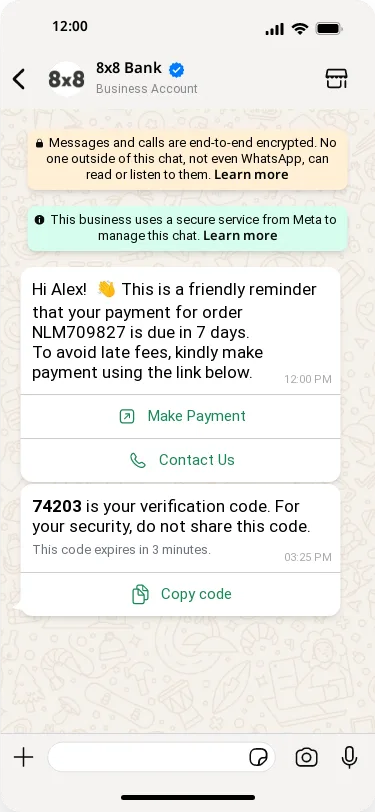
These are often the most straightforward WhatsApp Business use cases because they are tied to an existing transaction, booking, account or customer interaction.
A retailer might send an order confirmation immediately after checkout. A clinic could send an appointment reminder. An airline could notify a passenger about a schedule change. A hotel could provide check-in instructions before arrival.
The key is to keep the message aligned with its intended operational purpose. If a clinic adds an unrelated promotional offer to an appointment reminder, for example, the message may also take on a marketing purpose and should be assessed accordingly.
Read more: WhatsApp Business API: The Smart Way to Automate Delivery Notifications
Customer support and two-way conversations

WhatsApp can also be used as a customer service channel, allowing customers to start conversations and businesses to respond in the same place.
Customers might use it to:
- Ask about an order
- Reschedule an appointment
- Check delivery status
- Ask product questions
- Request assistance
- Continue a conversation with a business
When WhatsApp is connected to a CRM or customer-service platform, these conversations can be managed alongside other customer interactions rather than treated as isolated messages.
Marketing and promotional communications

WhatsApp can also be used for marketing, but businesses need to pay particular attention to consent and direct marketing requirements.
Promotional WhatsApp use cases can include product launches, special offers, loyalty campaigns, event invitations and personalized recommendations.
The same customer journey can contain different types of WhatsApp messages. A customer who provides their number to receive an order confirmation should not automatically be treated as having opted into unrelated marketing communications.
A useful rule is to ask:
What is the purpose of this particular message, and would the customer reasonably expect to receive it based on their interaction and preferences?
Keeping transactional, service and marketing communications clearly separated makes it easier to design appropriate consent journeys, manage customer preferences and deliver a WhatsApp experience that feels relevant rather than intrusive.
8×8 CPaaS supports these use cases, including customer support, automated notifications, marketing messages to opted-in customers, authentication, transaction alerts and interactive WhatsApp Flows. Your business can also connect WhatsApp with systems such as Salesforce, Zendesk and other business tools to bring conversations into existing workflows.
Read More: Turning Interest into Action with WhatsApp-Powered Customer Journeys
How Can 8×8 CPaaS Support WhatsApp Business Communications?
For businesses using WhatsApp to communicate with customers, having the right messaging capabilities is only part of the picture. You also need to consider how conversations are managed, how customer data is protected and how WhatsApp fits into your wider communication workflows.
8×8 WhatsApp Business API helps Philippine businesses integrate WhatsApp into marketing and customer journeys, enabling personalized conversations, automated notifications and interactive experiences at scale.
With the 8×8 Connect platform, WhatsApp can also work alongside SMS and voice through a central communications platform.

Key capabilities include:
- Dynamic two-way messaging: Engage your customers in real time through personalized, interactive conversations.
- Automated notifications: Keep customers informed with automated WhatsApp messages for appointment reminders, booking confirmations, order updates and other time-sensitive notifications.
- WhatsApp Flows: Create structured, multi-step experiences directly within WhatsApp. Your customers can complete actions, provide information or move through a process without being redirected to a separate website or app.
- Security and compliance: Support business communications with recognized security certifications and built-in controls such as 2FA, SAML-based SSO and number masking, helping you incorporate WhatsApp into your broader security and data-protection framework.
- Analytics and engagement insights: Track messaging and campaign performance through reporting and analytics, helping your business understand engagement, monitor customer journeys and identify opportunities to improve communications.
- Seamless CRM integration: Connect WhatsApp with platforms such as Salesforce, Zendesk and Freshdesk, giving your teams a more unified view of customer interactions and enabling conversations to fit into existing sales and support workflows.
- Marketing messages: Send personalized promotional messages to appropriately opted-in customers, supporting campaigns such as product launches, special offers, loyalty communications and event invitations.
Your business can also use 8×8 Converse to bring WhatsApp, SMS, voice, email, web chat and other channels into a single AI-powered workspace, helping customer-service teams manage conversations across channels without having to switch between separate tools.
A messaging API alone does not resolve the consent and data-handling questions covered above; it just moves them onto a new channel. The compliance controls here, such as 2FA, SAML-based SSO and number masking, sit on the same platform as the opt-in and CRM tooling, so the record of what a customer agreed to and the system enforcing it are not two separate things you have to reconcile.
For your business in the Philippines, these capabilities can support different customer journeys across industries, including finance, healthcare, retail, education, and more.
Talk to our experts to learn how 8×8 CPaaS can support you in building compliant, connected, and secure customer communication journeys across WhatsApp.