A retail marketing manager stares at her latest campaign results. Open rates look fine, but engagement tells a different story.
Her SMS blasts hit a 160-character wall. No product images, no branded sender name, no way to confirm if anyone actually read the message.
Meanwhile, a competitor sends a rich message with a scrollable product carousel, a verified brand logo, and a buy-now button. The customer taps, browses three items, and checks out without leaving the conversation.
That competitor is using Rich Communication Services (RCS). In the RCS vs SMS debate, the gap between what SMS can deliver and what customers now expect keeps widening.
What RCS Brings to Business Messaging
RCS upgrades the native messaging app on a customer’s phone into a branded, interactive channel.
Instead of plain text, businesses send high-resolution images, carousels, suggested replies, and action buttons. Every message displays a verified company name and logo.
In a Forrester Consulting study commissioned by Google, 119 marketing decision-makers reported click-through rates improving by 22% after adopting RCS, and 152 reported engagement up 40%. That is a materially different return from the same audience and the same contact list.
Read receipts give senders confirmation that messages were opened. Typing indicators create a conversational feel. Rich media turns a notification into an experience.
For businesses, the shift means higher engagement without changing the customer’s behaviour. Messages arrive in the same inbox where personal texts land, with no app download required.
RCS vs SMS: A Side-by-Side Comparison
The technical differences between RCS and SMS go well beyond character limits.
SMS caps messages at 160 characters with no native media support. RCS removes that ceiling, supporting up to 8,000 characters, images, video, audio, and interactive elements.
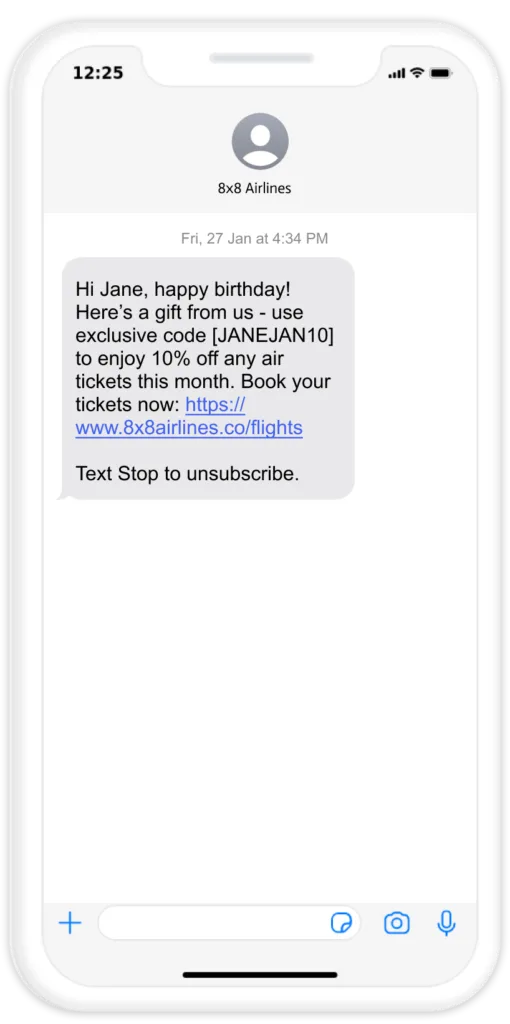
SMS shows a random phone number or short code as the sender. RCS displays your company name, logo, and a verification badge that confirms legitimacy.
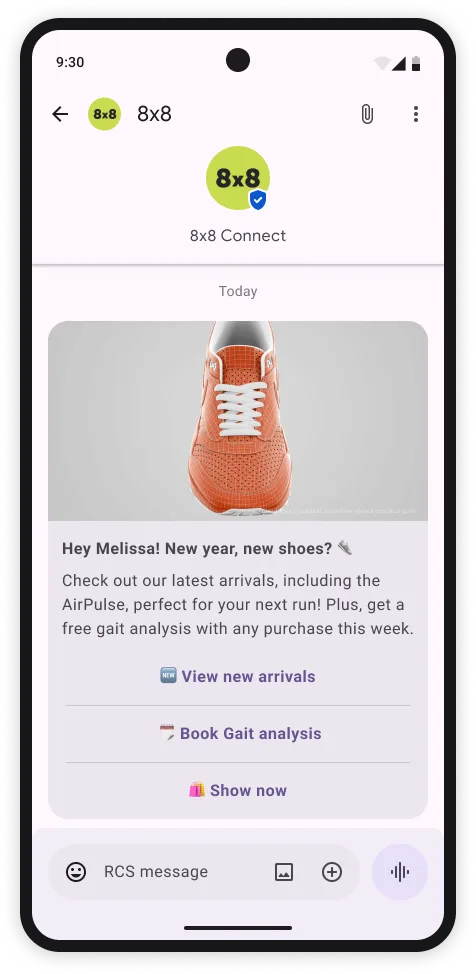
That verification matters. Recipients see a named brand and a checked badge before they open the message, not an unfamiliar short code.
SMS offers no delivery analytics beyond basic carrier reports. RCS provides read receipts, interaction data, and click tracking built into the protocol.
The result is a channel that looks and feels like a branded app experience, delivered through the messaging app customers already use every day. No download, no friction, no learning curve.
That shift lands differently in each industry.
The Apple Factor: Universal Reach (H2)
For years, RCS was an Android-only feature. That changed in September 2024 when Apple added RCS support in iOS 18.
The impact was immediate. Google reported a billion RCS messages a day in the United States in May 2025, averaged across the preceding 28 days.
Juniper Research forecasts RCS for Business traffic passing 200 billion messages globally by 2027, up from 70 billion in 2025.
With Apple on board, RCS now covers virtually every smartphone. Businesses no longer need to segment audiences by device type when planning messaging campaigns.
Growth is uneven across markets. Juniper attributes the gap to brand onboarding, which is still slower where verification has not been standardised.
That scale is not theoretical for 8×8 in Southeast Asia. aCommerce runs automated messaging across Thailand, Singapore, Malaysia, Indonesia, and the Philippines, reaching 120 million customers on 8×8 SMS.
Those are the same customer bases RCS upgrades, on the same numbers and the same platform.
The channel has moved well past pilot programmes into production deployment across industries.
Read More: Boost Engagement with RCS: The Next Generation of Messaging
Business Use Cases for RCS
RCS transforms messaging from a notification tool into a full customer interaction channel.
In retail, brands send scrollable product carousels with images, descriptions, and direct purchase buttons. Customers browse and buy without opening a separate app.
Airlines use RCS for boarding passes with real-time gate updates, seat upgrade offers, and quick-reply check-in confirmations. In Australia, carriers such as Qantas and Jetstar could apply the same model, sending boarding passes and live gate changes straight through RCS instead of a separate push notification, which matters given the sheer volume of domestic travel the market carries.
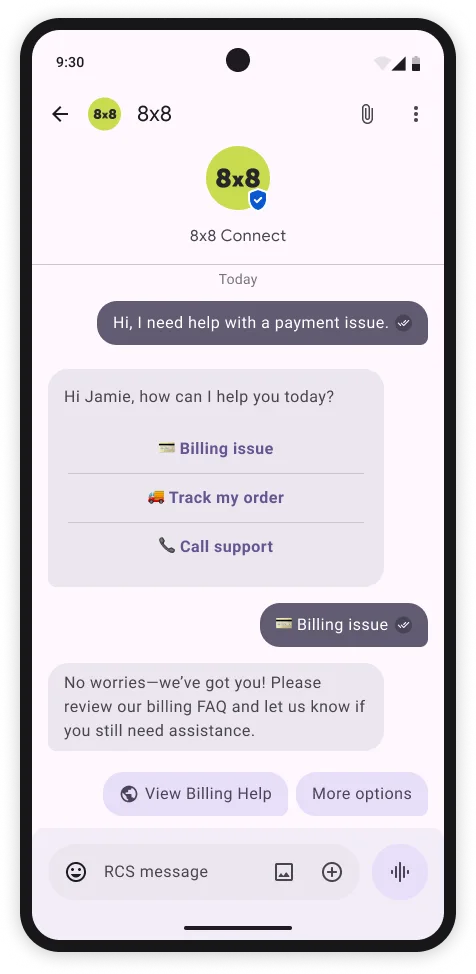
Customer service teams deploy RCS for interactive troubleshooting. Suggested reply buttons guide customers through resolution steps, cutting handle time and call volume.
Financial services providers send transaction alerts with rich detail: merchant name, amount, location map, and a one-tap dispute button.
Healthcare organisations send appointment reminders with confirm, reschedule, and cancel buttons. Patients respond in seconds instead of calling the front desk.
Cost and Performance: What the Numbers Show
RCS messages cost more per unit than SMS. But cost-per-message is the wrong metric for comparing these channels.
Those conversion figures are the reason. Rich, interactive messages drive far higher engagement from each send, so businesses need fewer of them to hit the same target.
Messages land with verified branding and interactive elements. Customers engage immediately rather than ignoring another plain-text notification.
Forrester’s study points to a second effect: average order value rises 7.5% to 12.5% after a business adopts RCS.
For flash sales and other revenue-carrying campaigns, that combination of better conversion and larger orders is the whole argument for paying more per message.
The arithmetic follows from there. At four times the conversion rate, a campaign that needs 1 million SMS sends to hit its target needs roughly 250,000 RCS sends.
A higher price per message can still produce a lower total campaign cost.
How 8×8 RCS Business Messaging Works
8×8 RCS Business Messaging gives businesses a programmable API for sending branded, interactive messages at scale.
Every message displays your company logo, name, and verification badge in the native messaging app. Customers see who sent the message before they open it.
The platform handles RCS-to-SMS fallback automatically. When a recipient’s device or carrier doesn’t support RCS, the message is delivered as standard SMS instead. No manual segmentation required.
8×8’s omnichannel messaging infrastructure connects RCS with SMS, WhatsApp, Viber, and other channels through a single integration. Businesses manage all messaging from one platform.
RCS is not a standalone channel here. Plenty of providers sell an RCS API; fewer run it on the same messaging infrastructure already carrying a business’s SMS, WhatsApp, and voice traffic, with fraud protection from Omni Shield covering the verification traffic underneath it.
Campaign analytics track delivery, read rates, clicks, and conversions across every RCS message. Teams see which content formats and calls to action drive the strongest results.
Read More: RCS for Business Messaging at Scale
Start Using RCS Instead of SMS
RCS is no longer a future bet. With near-universal device support, proven performance gains, and built-in SMS fallback, the channel is ready for production deployment.
Every message you send as plain SMS is a missed opportunity to show your brand, present your products visually, and let customers act without leaving the conversation.
Businesses that move now capture the engagement advantage before competitors saturate the channel.
Higher conversion rates, verified brand presence, and richer message formats add up to measurable revenue impact.
8×8 RCS Business Messaging makes the transition straightforward with programmable APIs, automatic fallback, and omnichannel integration. Talk to 8×8 to launch your first RCS campaign.
FAQ — RCS vs SMS
- What is the difference between RCS and SMS? SMS is a text-only format limited to 160 characters with no branding or media support. RCS adds rich media, interactive buttons, branded sender profiles, read receipts, and up to 8,000 characters per message.
- Do all phones support RCS messaging? Most modern Android phones and iPhones running iOS 18 or later support RCS. When a device or carrier does not support RCS, messages fall back to standard SMS automatically.
- Is RCS more expensive than SMS for businesses? RCS costs more per message than SMS. However, a Forrester Consulting study commissioned by Google found marketers who adopted RCS saw click-through rates improve by 22% and engagement rise by 40%, which means businesses often need fewer messages to achieve the same results.
- Can RCS messages fall back to SMS? Yes. Platforms like 8×8 RCS Business Messaging include automatic SMS fallback. If a recipient’s device doesn’t support RCS, the message delivers as standard SMS without manual intervention.
- What industries benefit most from RCS? Retail, airlines, financial services, and e-commerce see the strongest results. Any industry sending high-volume transactional or promotional messages benefits from the richer engagement format.