
Choosing an SMS or OTP verification provider in Australia depends on what you need to send, how you authenticate users and where your customers are located. Providers differ in SMS infrastructure, OTP capabilities, verification channels, pricing, Sender ID support, developer tools and fraud controls.
This guide compares eight providers to help you understand how their SMS and verification capabilities differ.
Whether you need OTPs for customer logins, transaction authentication or account registration, the right provider should support your technical requirements while meeting the messaging and regulatory considerations that apply in Australia.
What to Check Before Choosing an Australian SMS Gateway or OTP Verification Provider?
An SMS gateway does more than send messages from an application to a mobile number. For Australian traffic, the provider you choose can affect sender presentation, delivery performance, compliance requirements, reporting and how easily you can handle failed or suspicious traffic.
Before choosing a provider, check the following.
1. Sender ID registration requirements
If you are sending application-to-person (A2P) SMS in Australia, check how the provider handles Sender ID registration under the ACMA’s SMS Sender ID Register, introduced under the Telecommunications (SMS Sender ID Register) Industry Standard 2025. Registration is mandatory, and from 1 July 2026, Sender IDs that are not registered will be labelled “Unverified” to recipients.
Ask whether the Sender ID you want to use can be registered and how the provider routes registered and unregistered (“Unverified”) Sender IDs. You should also clarify which party is responsible for submitting the required information and what needs to be completed before sending traffic. Note that this Sender ID scheme is separate from Australia’s SMS marketing and consent requirements under the Spam Act 2003, which is enforced by the ACMA and governs consent for commercial messages rather than sender identification.
2. Australian carrier routes and delivery
A provider’s global coverage does not necessarily tell you how well your messages will perform in Australia.
Ask which carrier or aggregator routes are used for Australian traffic and whether the provider can provide delivery reporting. For OTPs in particular, delivery speed matters because a code that arrives after it has expired is not useful to the user.
If Australia is a key market, ask for information on expected delivery performance, route quality and how failed deliveries are handled.
3. OTP templates and message handling
For verification traffic, check how much control you have over OTP messages.
Depending on the provider, you may be able to configure the message template, OTP length, expiry period, language and other verification settings. Check whether the service supports the format and message flow your application requires, and whether Australia-specific messaging requirements affect the template.
4. Delivery reporting
Look for more than a simple “sent” status.
Useful reporting can show whether messages were delivered, failed or delayed, and may provide information that helps you identify problems with a particular route or destination.
For high-volume OTP traffic, this visibility can help teams distinguish an application problem from a messaging delivery problem.
5. API and SDK support
Consider how the SMS service will fit into your existing technology stack.
Check whether the provider offers the APIs, SDKs, documentation and developer tools your team needs. For verification products, also look at how the API handles OTP generation, validation, expiry, retries and verification results.
A simple SMS API may be sufficient if you already have your own authentication logic. A managed verification API can reduce the amount of this workflow you need to build yourself.
6. Fallback channels
SMS is widely used for OTPs, but it is not always the only option.
If verification is business-critical, check whether the provider supports fallback to channels such as voice, WhatsApp or other authentication methods. More importantly, check whether fallback can be triggered based on delivery status or configured as part of the verification journey.
This can help when an SMS is delayed, unavailable or unsuitable for a particular user.
7. Fraud protection
OTP traffic can also create a fraud risk. Attackers can abuse verification forms to trigger large numbers of messages to controlled numbers, creating unnecessary messaging costs or using your service for artificial traffic.
Ask what controls the provider offers against SMS pumping, unusual verification activity, excessive retries and other suspicious traffic patterns.
Rate limits, traffic monitoring and fraud detection can be useful, particularly for public-facing applications with high-volume login or registration flows.
8. Pricing structure
Finally, look at the full cost of sending and verifying messages rather than comparing SMS rates alone.
Check whether the provider charges per SMS segment, verification attempt or successful verification, and whether voice or other fallback channels have separate fees. Also look for carrier fees, minimum commitments, volume discounts and differences between PAYG and subscription plans.
For a fair comparison, estimate the cost based on your actual expected verification volume and the complete user journey.
Before signing up, ask each Australian SMS gateway provider:
| What to check | Questions to ask |
| Sender ID | Can you register and use your required Sender ID in Australia? |
| Routing | Which routes and carriers will handle your Australian traffic? |
| Delivery | What delivery reporting and performance data are available? |
| OTP | Can you configure expiry, retries, templates and OTP length? |
| Integration | Which APIs, SDKs and developer tools are available? |
| Fallback | Can verification fall back to voice or other channels? |
| Fraud | What controls are available for SMS pumping and suspicious traffic? |
| Pricing | What will you pay for delivery, verification, retries and fallback? |
The right SMS gateway is therefore not necessarily the provider with the lowest advertised SMS rate. For Australian deployments, sender requirements, delivery performance, integration, verification capabilities and the total cost of the messaging journey all matter.
How Much Does SMS OTP Cost in Australia?
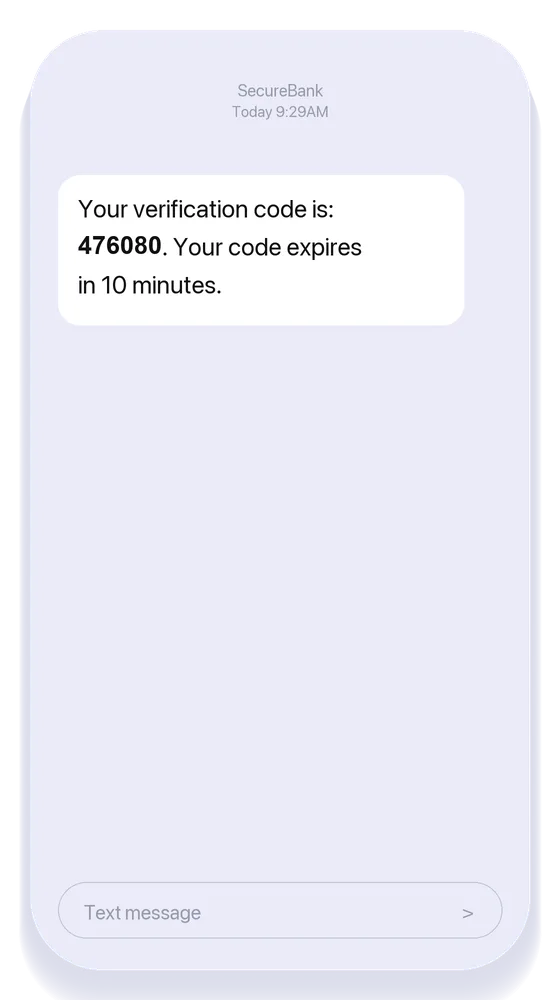
There is no single price for SMS OTP in Australia. The total cost can depend on the SMS provider, delivery route, message length, verification method and whether the provider charges a separate verification fee.
For a basic SMS OTP flow, you may pay for the SMS itself. A managed verification service can add another fee for generating and validating the OTP, while some providers bundle parts of the verification workflow into their pricing.
What makes up the cost of SMS OTP?
Common pricing components of SMS OTP include:
- SMS delivery: The charge for sending the OTP message, usually priced per message or per SMS segment.
- Verification fees: Some managed verification services charge a separate fee when an OTP verification is successfully completed.
- Additional channels: Voice, WhatsApp, email or other fallback channels may have their own delivery charges.
- Carrier fees: Some providers may pass through additional carrier or destination-related charges.
- Message segments: Longer SMS messages can be split into multiple segments, with each segment potentially charged separately.
- Failed or undelivered messages: Depending on the provider and pricing model, failed delivery attempts may still incur a charge.
- Volume or contract commitments: Subscription and enterprise plans may offer different rates from pay-as-you-go pricing.
This means two providers can appear to have similar SMS rates while producing different total costs for the same verification journey.
SMS delivery fees vs verification fees
One important distinction is whether you are buying SMS delivery or a managed verification service.
With an SMS API, you typically pay for the message sent to the user’s phone. Your application may handle OTP generation, expiry, retry limits and validation separately.
With a verification API, the provider can manage more of this workflow. Depending on the service, you may be charged for the successful verification in addition to the underlying SMS or other channel costs.
For example, a provider may charge a verification fee when the user successfully completes an OTP check, while the SMS used to deliver the code is charged separately.
This is why comparing only the advertised SMS rate can give an incomplete picture of your actual verification costs.
Before comparing quotes, define your expected monthly verification volume, target markets, preferred channels and typical number of OTP attempts per successful verification. This gives you a more useful basis for comparing providers than the SMS rate alone.
What Are the Best SMS & OTP Verification Providers in Australia in 2026?
Disclaimer: All prices and service information in this article are accurate as of September 2026. Rates and services may change without notice and can vary based on destination country, mobile operator, message length, currency exchange rates, and other factors.
Do confirm current Australian pricing and scope directly with each provider before making a purchasing decision.
-
8×8 CPaaS
8×8 CPaaS provides programmable SMS for businesses that need to send application-triggered messages at scale. Its SMS capabilities include bulk messaging, custom Sender IDs, delivery reporting and API access, with connectivity across international markets.
SMS and messaging capabilities
8×8 CPaaS supports SMS alongside other business messaging channels, including WhatsApp, Viber, Zalo and LINE. This gives businesses the option to use SMS for transactional or time-sensitive communications while using other channels where appropriate.
Its SMS offering also includes intelligent routing and message adaptation capabilities, which can help manage delivery across different destinations and networks. Delivery reporting provides visibility into message performance after sending.
For teams building SMS into their own applications, the API can be used to trigger messages from business systems and workflows rather than relying solely on a messaging dashboard. A verification journey can therefore be structured around multiple authentication methods rather than relying on a single SMS attempt.
OTP and verification
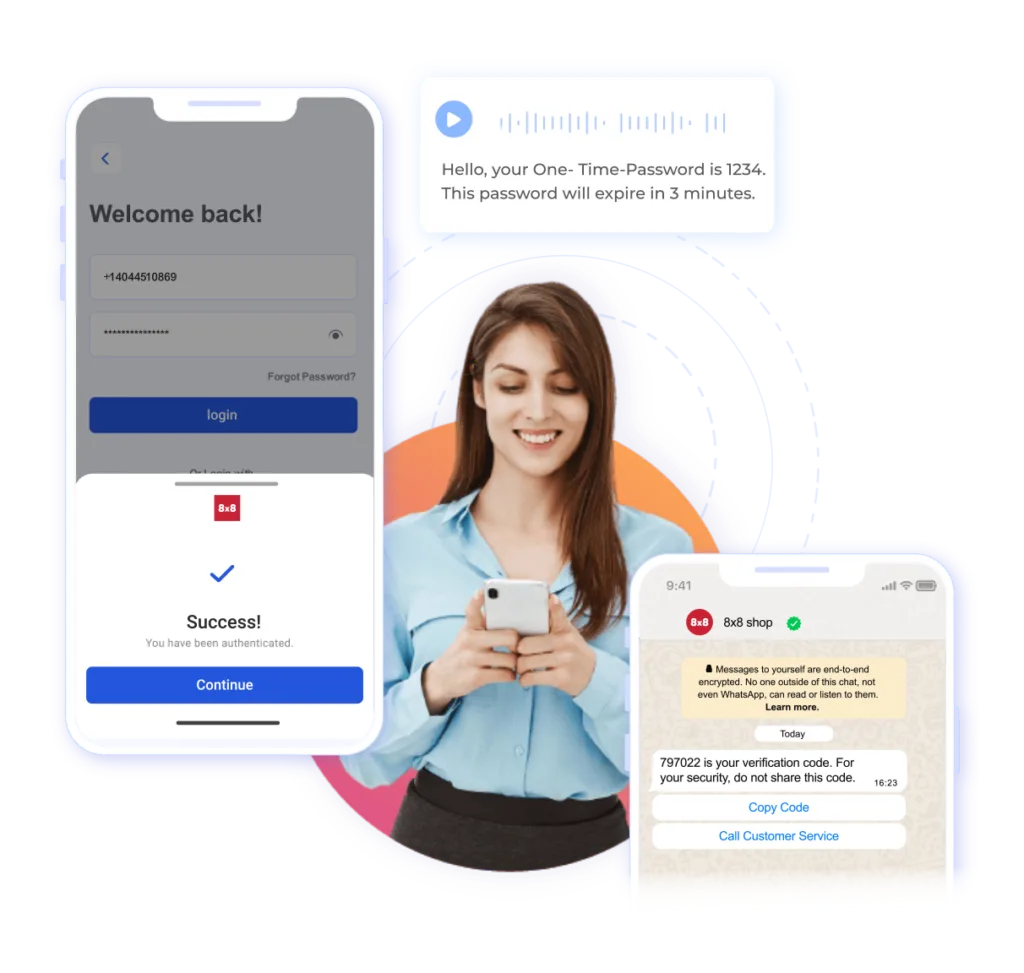
Verification can run through three channels – a login screen confirming “You have been authenticated,” a voice message reading out the code, and a WhatsApp OTP as a fallback. For authentication use cases, the 8×8 CPaaS Verification API supports SMS OTP, voice OTP, WhatsApp, Viber and Silent Mobile Authentication.
The verification journey can be configured around different channels and fallback rules. For example, an application could first attempt Silent Mobile Authentication, fall back to SMS OTP if that is unavailable, and escalate to voice OTP when necessary.
Businesses can configure elements such as OTP length, expiry, Sender ID, language, retry intervals, channel priority and fallback logic based on delivery status or availability.
Fraud prevention measures
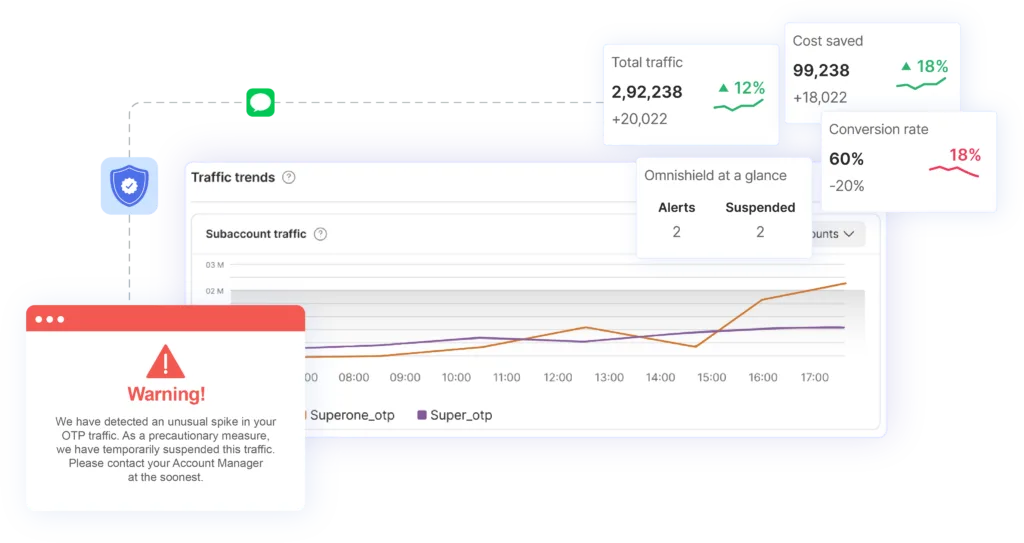
Omni Shield flags any OTP traffic spike and suspends it automatically, preventing SMS pumping fraud. For high-volume consumer applications, fraud controls can be an important part of provider selection alongside basic OTP delivery. 8×8 CPaaS also offers Omni Shield as a fraud-protection layer for verification traffic. Its stated use cases include detecting artificially inflated traffic, toll fraud and suspicious verification behaviour, as well as verifying that numbers are active and responsive.
Management and engagement platforms
For teams that prefer a management interface alongside API-based messaging, 8×8 Connect provides a portal for managing SMS and other communications. It can complement the developer-facing capabilities of 8×8 CPaaS, giving teams visibility into messaging activity and reporting alongside their integrated workflows.
Meanwhile, 8×8 Converse is a unified, AI-powered conversational platform that brings customer interactions from channels such as WhatsApp, Facebook Messenger and email into a single agent dashboard. It can be used alongside 8×8 CPaaS by teams that want to manage customer engagement and conversations in one place.

With 8×8 Converse, a conversation moves from WhatsApp chat to a WhatsApp Call without losing context. 8×8 CPaaS can be relevant to:
- Banking and fintech applications
- E-commerce and marketplace platforms
- Travel and mobility applications
- High-volume consumer applications
- Businesses operating across APAC
- Applications that need voice fallback when SMS is unsuccessful
- Organisations looking to add fraud controls to high-volume verification traffic
- Enterprises that want authentication and broader communications APIs from the same provider
Pricing
8×8 CPaaS SMS plans include pay-as-you-go, subscription and custom enterprise options, with a stated minimum monthly spend of US$500.
8×8 Verification API uses a different pricing structure: each verification attempt incurs a message fee based on the destination and channel, while services like Verif8 can be configured to apply a conversion fee for successful verifications.
Industry Recognition
8×8 CPaaS was recognised as Best CPaaS Platform at the CX Awards 2025 by CX Today, providing independent industry recognition of its CPaaS offering. The judges highlighted 8×8’s “high level of composability” and its ability to integrate communications across internal tools and UCaaS solutions on a modular platform.
In 2026, 8×8 was also named a MetriStar Top Provider for CPaaS by independent research firm Metrigy, and received the same recognition for Contact Centre as a Service (CCaaS). Metrigy noted that 8×8 is one of a small number of vendors offering CPaaS, CCaaS and UCaaS on a single platform, and highlighted its approach of treating CPaaS as a programmable layer across the CX stack, extending engagement beyond the contact centre to sales, field service and frontline teams.
-
Twilio
Twilio provides programmable SMS through its messaging APIs, allowing businesses to send transactional notifications, alerts, authentication messages and other application-triggered communications. Its wider communications platform also supports channels such as WhatsApp, voice and email.
For verification, Twilio Verify provides a managed workflow for generating, delivering and validating OTPs. Depending on market and configuration, verification can use SMS, voice, WhatsApp, email, passkeys, TOTP, push and Silent Network Authentication.
Typical use cases: SaaS platforms, marketplaces, fintech applications and international digital products that need programmable messaging alongside authentication.
Fraud prevention measures: Twilio Verify includes Fraud Guard, which analyses current and historical SMS traffic, detects unusual destination patterns and automatically blocks suspicious OTP messages.
Pricing: Twilio Verify currently charges a base price of US$0.05 per successful verification on top of applicable channel fees. Custom pricing is available for higher volumes.
-
Vonage
Vonage offers programmable SMS for business messaging, including transactional communications and application-triggered notifications. Its communications platform also extends across channels such as voice, WhatsApp and RCS.
Vonage Verify adds a managed two-factor authentication workflow covering OTP generation, delivery and PIN verification. Depending on product configuration and market availability, verification can use SMS, voice, WhatsApp, RCS, email and Silent Authentication.
Typical use cases: International businesses looking for flexible authentication channels across different markets.
Fraud prevention measures: Vonage applies Fraud Defender to Verify traffic, using SMS-pumping protection, geographic permissions, velocity controls and rate limiting.
Pricing: Vonage Verify charges €0.052/US$0.06084 per successful verification, with custom quotes available for larger volumes.
Vonage’s SMS pricing page for Australia notes that rates are updated periodically and that the customer dashboard should be used for the most accurate pricing in Australia.
-
Infobip
Infobip provides programmable SMS for transactional messaging, notifications and customer communications, backed by a broad international connectivity footprint. Its wider platform also covers channels such as voice, email, WhatsApp and other messaging services.
For authentication, Infobip offers a dedicated 2FA API for generating OTPs, delivering them to users and validating submitted PINs. OTP delivery is available through SMS, voice and email, allowing businesses to build verification flows across multiple channels.
Typical use cases: Large organisations requiring authentication alongside international messaging and customer engagement capabilities.
Fraud prevention measures: Infobip Signals uses artificial intelligence and machine learning to analyse OTP traffic, phone-number behaviour, number ranges and traffic patterns in real time
Pricing: Infobip uses a pay-as-you-go model with destination-based SMS pricing. Its public pricing page states that the displayed price is an average across supported networks for each country and that the exact price can vary according to destination network, applicable discounts and route.
-
Sinch
Sinch provides programmable SMS for business messaging, with APIs and developer tools for sending application-triggered communications. Its broader communications offering also includes voice and other customer engagement channels.
Sinch Verification focuses on phone-number verification, primarily through SMS OTP, flash calls, and data verifications. Verification callbacks allow applications to receive updates on verification requests and results, while supported mobile implementations can also reduce manual OTP entry.
Typical use cases: Mobile applications and product teams looking for a focused phone-number verification service.
Fraud prevention measures: Sinch supports fraud reduction through features such as SMS SenderID protection and AI-powered real-time monitoring of message content and volume.
Pricing: Sinch publishes destination-based SMS pricing for Australia via its pricing page. Meanwhile, Verification pricing is calculated per request. SMS verification attempts are charged according to the SMS price for the destination country and operator. The current price list is available through Sinch’s Build dashboard.
-
Bird
Bird provides SMS messaging as part of its broader omnichannel communications platform, supporting application-triggered messages and customer engagement alongside channels such as email and WhatsApp.
Bird Verify provides one-time-code verification through SMS, email and WhatsApp. The workflow allows businesses to send a code to a recipient and validate the submitted code as part of an authentication journey.
Bird can be relevant when businesses want verification to sit alongside broader SMS, WhatsApp and customer engagement workflows.
Typical use cases: Teams combining authentication with omnichannel customer engagement.
Fraud prevention measures: Bird Verify applies platform-level OTP caps and recipient-based rate limits to reduce SMS pumping and abuse.
Pricing: Bird’s SMS services operate on a pay-as-you-go basis. Bird’s SMS pricing for Australia is destination-based; check Bird’s pricing page for current rates. Separate charges apply for monthly targeted contacts or enterprise volume setups.
Bird states that Verify itself is free. Customers pay only for the channel used to send the code. The charge applies when the code is sent; checking the code is free.
-
Telnyx
Telnyx provides programmable SMS and communications infrastructure for businesses that want API-level control over messaging and other communication services. Its platform also supports voice, WhatsApp and other programmable channels.
Telnyx Verify provides OTP generation and validation through SMS, voice, WhatsApp and flash calls. Its API workflow covers creating a verification, delivering the code and submitting the user’s response for validation, with controls such as rate limiting available for verification workflows.
Telnyx Verify is relevant to technical teams looking for API-level control, multiple verification channels and programmable communications infrastructure.
Typical use cases: Engineering-led organisations that want programmable communications infrastructure and control over verification workflows.
Fraud prevention measures: Telnyx recommends a layered fraud-control process, including limits such as three attempts per phone number in 10 minutes, five attempts per hour, 10 attempts per IP address per hour and continuous monitoring for traffic spikes.
Pricing: Telnyx publishes a verification charge of US$0.03 per successful verification, plus the underlying channel cost, whether SMS, WhatsApp, voice call, or flash call.
Telnyx publishes destination-based SMS and RCS pricing for Australia via its pricing page.
-
Plivo
Plivo provides programmable SMS for transactional messaging and application-driven communications, alongside voice and other communications capabilities. Its APIs allow businesses to integrate messaging into their own applications and workflows.
Plivo Verify provides SMS and voice OTP verification through a managed workflow. Businesses can configure settings such as OTP length, expiry interval and message template, then create verification sessions and validate submitted codes.
Typical use cases: Businesses looking for programmable SMS and a focused SMS/voice verification workflow.
Fraud prevention measures: Plivo Verify includes Fraud Shield at no additional cost to detect and block artificially inflated traffic, SMS pumping and suspicious destination patterns.
Pricing: Plivo states that Verify has a US$0 verification fee and that customers pay only for the delivery channel. Plivo’s SMS channel fee for Australia is destination-based; check Plivo’s pricing page for current rates.
| Provider | SMS capabilities | OTP & verification | SMS pricing | Verify pricing |
| 8×8 CPaaS | SMS API, bulk SMS, Sender IDs, delivery reporting | SMS OTP, voice OTP, WhatsApp, Viber, Silent Mobile Authentication | PAYG / subscription/enterprise; destination- and carrier-dependent | Message fee + conversion fee on successful verification; varies by destination and channel |
| Twilio | Programmable SMS and messaging APIs | Managed Verify with SMS, voice, WhatsApp, email, passkeys, TOTP, push and SNA | Destination/carrier-based; check current Australian rate | US$0.05/successful verification + channel fees |
| Vonage | Programmable SMS and messaging APIs | Managed OTP generation, delivery and PIN verification | Destination/carrier-based; check current Australian rate | US$0.06084 per successful verification |
| Infobip | Programmable SMS with broad international connectivity | Dedicated 2FA API for OTP generation, delivery and validation | Destination/route-based; Australian quote recommended | Check current pricing/quote |
| Sinch | Programmable SMS and business messaging | SMS OTP verification with API/SDK support | Destination-based; check Sinch’s pricing page | Check current Verification pricing |
| Bird | SMS API and omnichannel messaging | Verify via SMS, email and WhatsApp | Pay-as-you-go; destination-based (check Bird’s pricing page) | US$0 verification fee; pay applicable channel fee |
| Telnyx | Programmable SMS and communications infrastructure | SMS, voice, WhatsApp and flash-call verification | Destination-based SMS and RCS pricing (check Telnyx’s pricing page) | US$0.03 per successful verification + channel fee |
| Plivo | Programmable SMS API | SMS and voice OTP verification | Destination-based (check Plivo’s pricing page) | US$0 verification fee; pay channel charges |
Choosing an SMS and OTP Provider for Your Business
The right provider depends on what you need your SMS and verification setup to do.
If your priority is straightforward SMS messaging, an SMS API with reliable Australian delivery and clear pricing may be enough. If you’re building authentication into a high-volume application, you may also want managed OTP workflows, multiple verification channels, fallback options and fraud controls.
For businesses operating across Australia and the Asia-Pacific region, it’s also worth looking beyond headline SMS rates. Sender ID requirements, carrier routes, delivery performance, API capabilities and the total cost of each verification journey can all affect the practical fit of a provider.
Why Consider 8×8 CPaaS?
8×8 CPaaS combines programmable SMS with SMS and voice OTP, WhatsApp, Viber and Silent Mobile Authentication. Beyond the technology itself, businesses can also access:
- Fast onboarding – Get your messaging channels set up with expert onboarding support.
- Local, dedicated support – Work with a dedicated Account Manager and access 24/7 customer and technical support from local offices.
- Transparent pricing – Choose an all-inclusive monthly fee with a one-time setup fee, with no additional fees for subsequent template setup.
- Enterprise integrations – Connect APIs, SDKs and webhooks with your existing Contact Centre, CRM and other business systems.
- Scalable infrastructure – Support growing messaging volumes with high availability, adaptable architecture and global reach.
- Reliable network quality: 8×8 runs its own end-to-end network with direct carrier links, giving it control over routing, quality and uptime for dependable, low-latency delivery, especially for voice and high-volume SMS.
- Global reach, local compliance: Available in 190+ countries, with in-country numbers, regional data centres and built-in support for GDPR, HIPAA and the Australian Privacy Principles (APPs) under the Privacy Act 1988.
- Enterprise-focused pricing: As a carrier-agnostic provider, 8×8 secures competitive global rates and optimises routes for quality and cost, using tools like Number Lookup to cut wasted traffic and spend.
Talk to our experts to learn how 8×8 CPaaS SMS and verification capabilities can support your customer communication and authentication workflows.
Frequently Asked Questions
- What is an SMS provider? An SMS provider enables businesses to send SMS messages to customers through an API, platform or other messaging infrastructure. Depending on the provider, services can include transactional SMS, bulk messaging, Sender ID support, delivery reporting and integrations with business systems.
- What is an SMS gateway? An SMS gateway connects an application or business system to mobile networks so it can send SMS messages to users’ phones. Many modern SMS providers expose their gateway infrastructure through an API, allowing developers to integrate SMS directly into websites, apps and other systems.
- What is an SMS API? An SMS API is a software interface that allows an application to send and manage SMS messages programmatically. Instead of manually sending messages from a dashboard, your application can trigger an SMS when an event occurs, such as a login attempt, order update or appointment reminder.
- How much does SMS OTP cost in Australia? SMS OTP pricing varies by provider and can depend on the SMS rate, number of segments, carrier or route, verification fees, retries and additional channels. Some providers charge separately for successful verification, while others charge only for the underlying SMS or communication channel.
- Do I need to register a Sender ID for SMS in Australia? Yes. Businesses sending application-to-person SMS in Australia must register their Sender ID under ACMA’s SMS Sender ID Register, introduced under the Telecommunications (SMS Sender ID Register) Industry Standard 2025. Registration is mandatory, and from 1 July 2026, unregistered Sender IDs are labelled “Unverified” to recipients. Confirm the current requirements before launching SMS campaigns or transactional messaging.
- Can OTP verification use channels other than SMS? Yes. Depending on the provider and market, verification can also use channels such as voice, WhatsApp, email, push authentication or other mobile authentication methods. Using multiple channels can allow businesses to create fallback options when SMS delivery is delayed or unavailable.